Best of UK & Ireland Tour Review: An Insider’s Honest Take

By Matt Grieves — Expat Explore Tour Leader
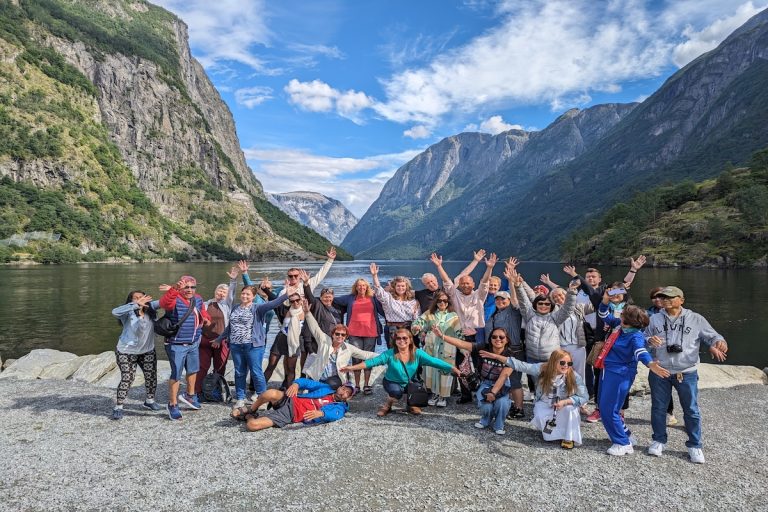
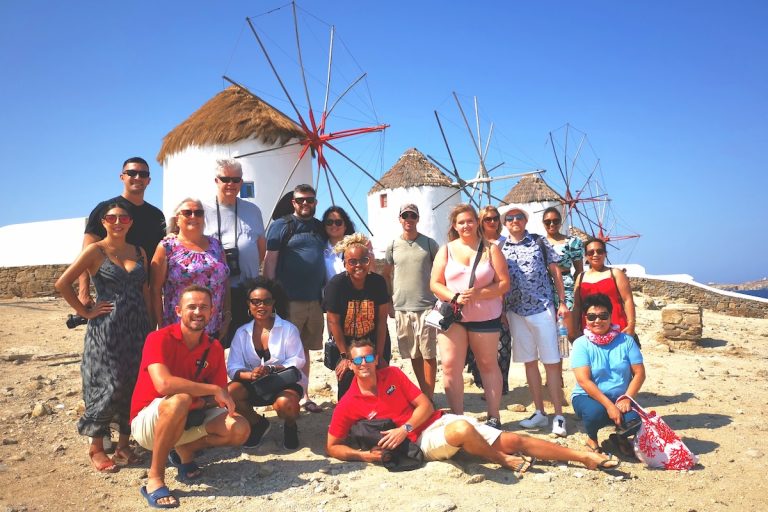
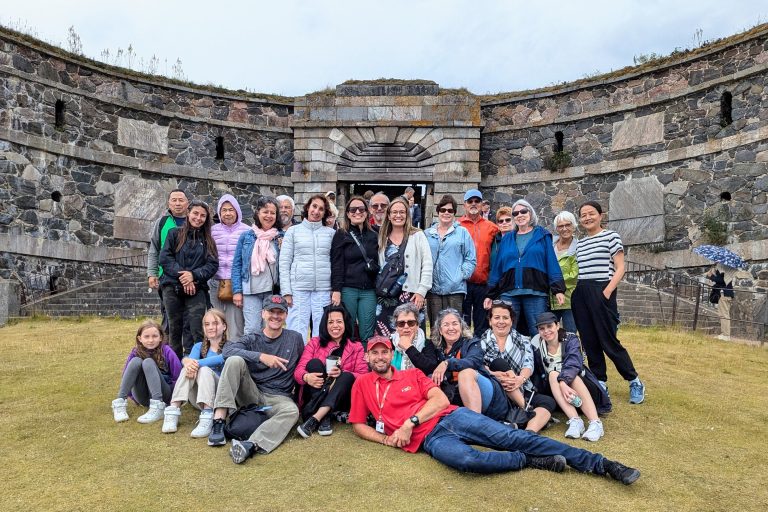
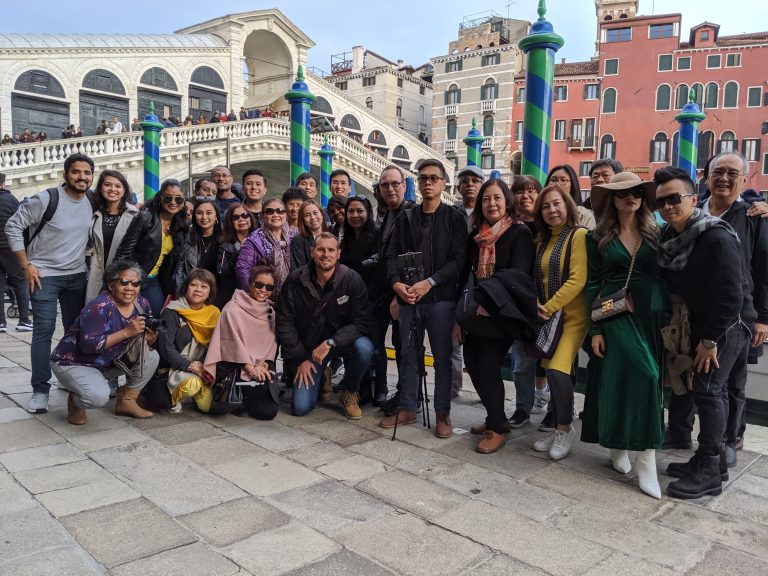
I first ran the Best of UK & Ireland tour in 2022, and I still remember it vividly, mostly because of the group. They were an incredible bunch, and it all came together on night two in Liverpool, when I took them to the Cavern Club, where the Beatles played before the world knew their name.
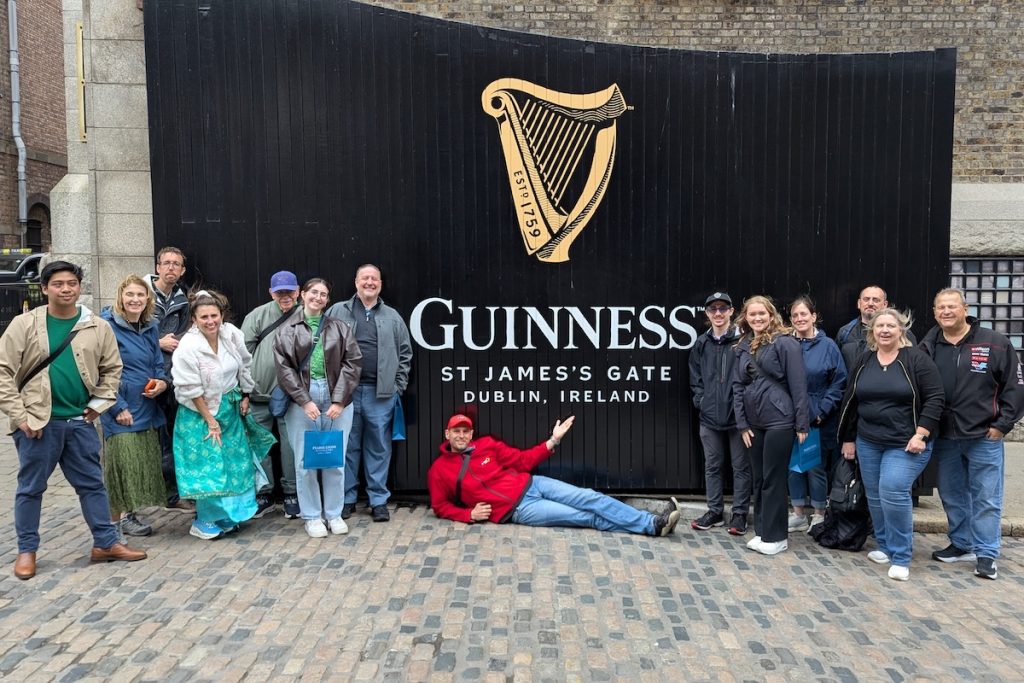
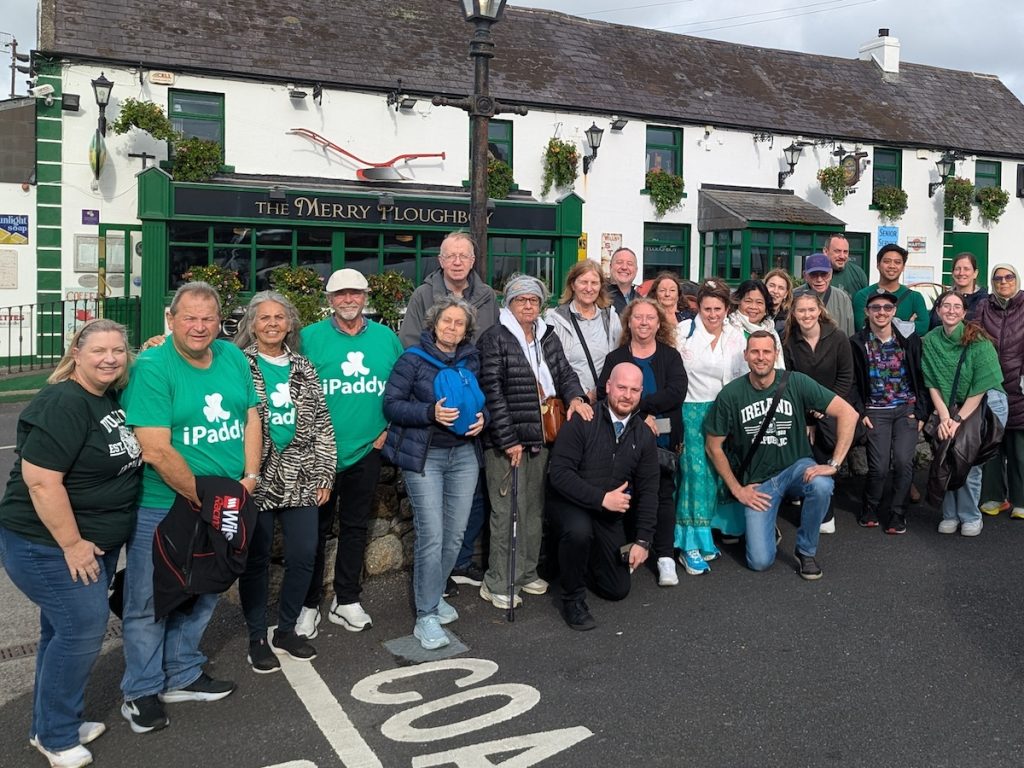
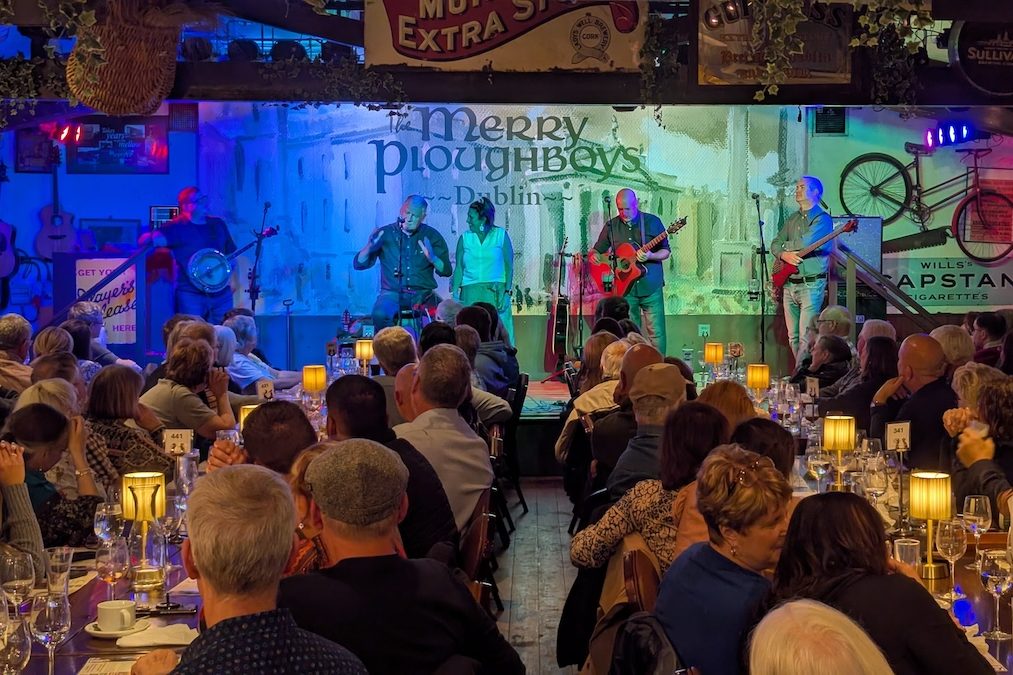
After a few hours of live music, we wandered down to The Grapes, the pub where the band used to drink between sets. The karaoke came out. The night ran very late. But that’s how the best tours begin. With the group bonded, we drank Guinness together in Dublin, sang our hearts out at the Merry Ploughboys, and toasted with whisky over Scottish ballads.
It wasn’t all pubs and late nights, of course. Between them we saw ancient castles, storybook villages, emerald landscapes, and royal pageantry alongside modern pop culture. This is exactly what draws millions of visitors to these islands every year, and it’s what the Best of UK & Ireland tour is built to show off.
I saw first-hand why it’s one of Expat Explore’s most highly rated tours. The pacing is well balanced, and every stop adds something the last one didn’t. Yes, there’s plenty of driving, these islands are small but astonishingly dense with things to see, yet no two days ever feel the same.
In this review, which goes considerably further than anything you’ll find on the official website, I’ll give you the honest, inside perspective: what the itinerary really feels like day to day, which optional excursions are genuinely worth it, and, crucially, whether this tour is right for you.
Quick Overview
Tour Highlights
- Edinburgh: Edinburgh Castle dominates the city skyline and wandering the Royal Mile feels like stepping back into the middle ages (you just need to ignore the souvenir stores).
- Dublin: Enjoy an evening exploring the vibrant Temple Bar area famed for its live music venues, as well as a full day to soak in the history of the city.
- York: Your best chance to walk medieval city walls.
- Ring of Kerry: With a horse and carriage ride, sheepdog shows, and a bog village experience, this is the best drive day of the tour.
- Alnwick Castle: An underrated and unexpected gem.
- Bath: The most beautiful city in the whole of the UK and Ireland.
Tour Details
- Operator: Expat Explore
- Duration: 13 days / 12 nights
- Route: London to London
- Countries visited: 5 (England, Wales, Ireland, Northern Ireland, Scotland)
- Operates: April to October
- Group format: Non-split tour, the same group from start to finish
If 13 days is too long, there are two separate 7-day tours available: the Irish Explorer and the Great Britain tour (more on both later).
Ready to join?
Use promo code TOURLEADERSJOURNAL for 5% off any Expat Explore tour.
The Itinerary: A Storytelling Journey Through the British Isles
Rather than a dry day-by-day list, let me walk you through the tour the way it actually unfolds, because this itinerary has a genuine narrative arc, moving through distinct chapters that each feel completely different from the last.
Chapter One: England & Wales — Ancient Stones and Storybook Villages
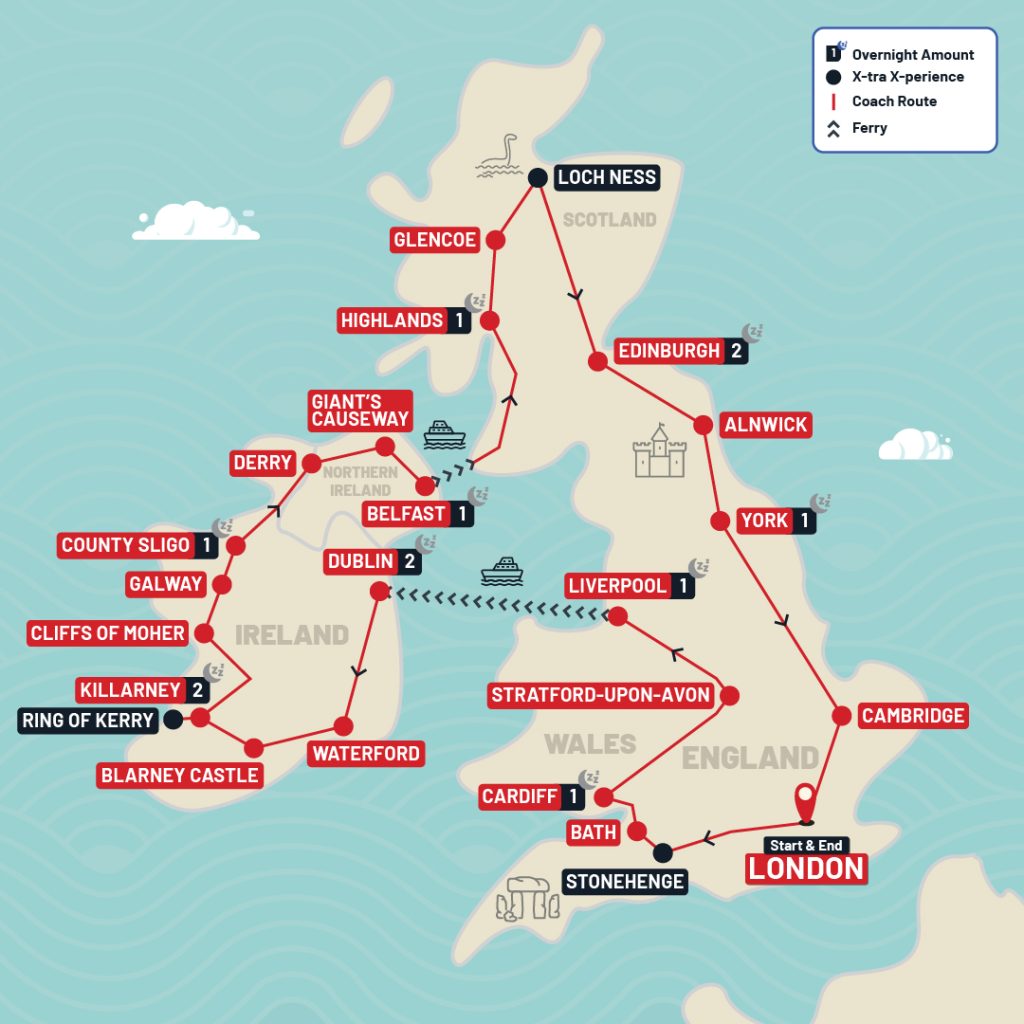
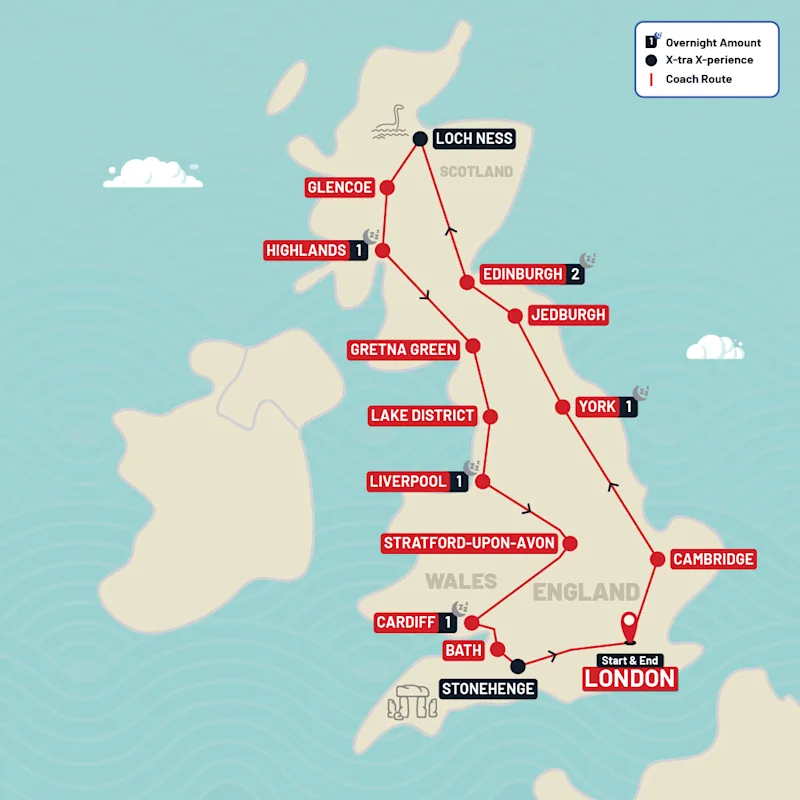
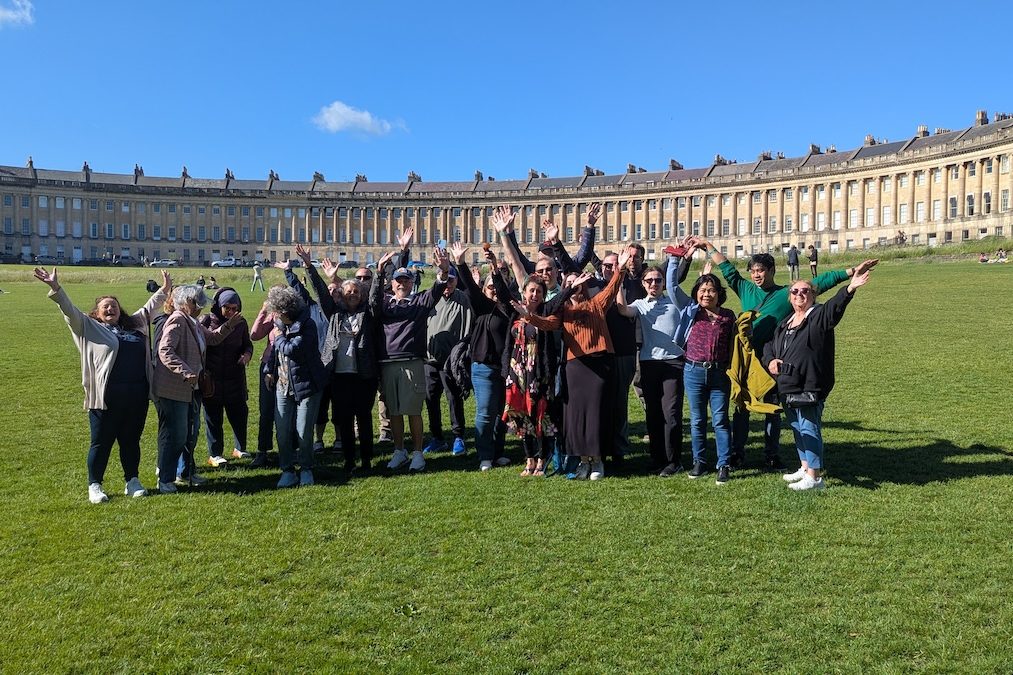
(Days 1–3: London → Stonehenge → Bath → Cardiff → Stratford-upon-Avon → Liverpool → Conwy → Holyhead)
The tour doesn’t actually explore London, it’s just the start and finish point. London is best experienced on foot and by tube, not from a coach window, so save it for before or after the tour.
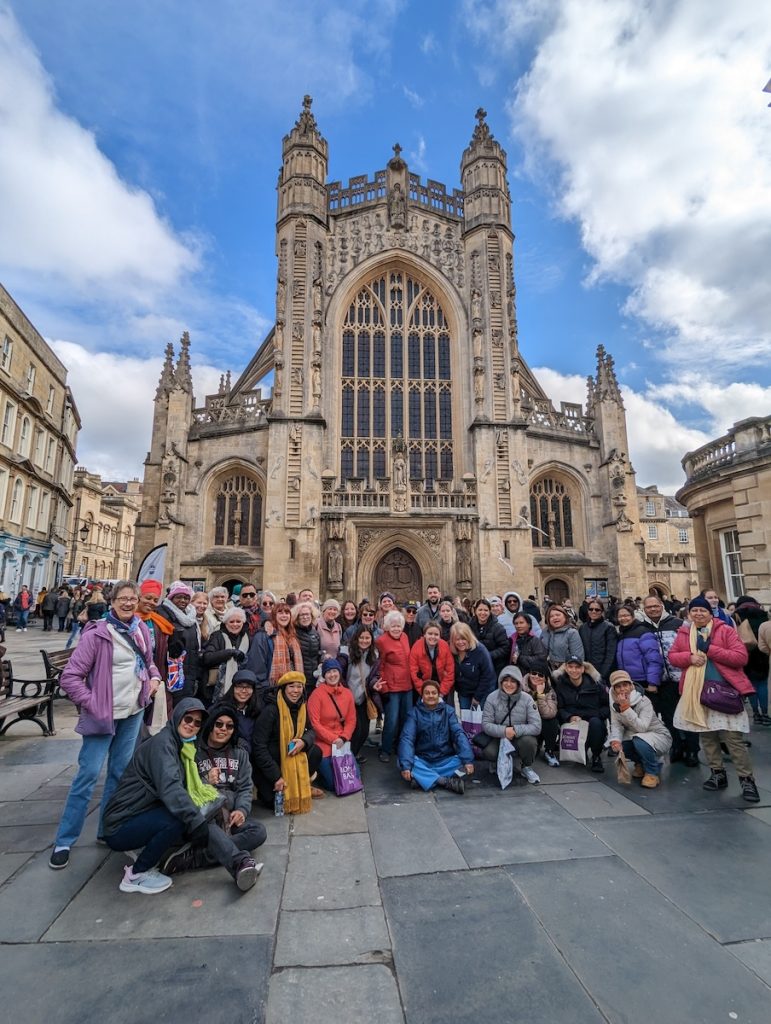
I promised you variety, and day one delivers it immediately. You leave one of the biggest cities in the world and, a few hours later, arrive at one of the ancient world’s wonders: Stonehenge. Some people write it off as “just a pile of rocks.” I’d like to see them drag those stones hundreds of kilometres and stack them in perfect alignment with the sun. It’s the perfect first stop, taking you right back to the beginning of these islands’ story.
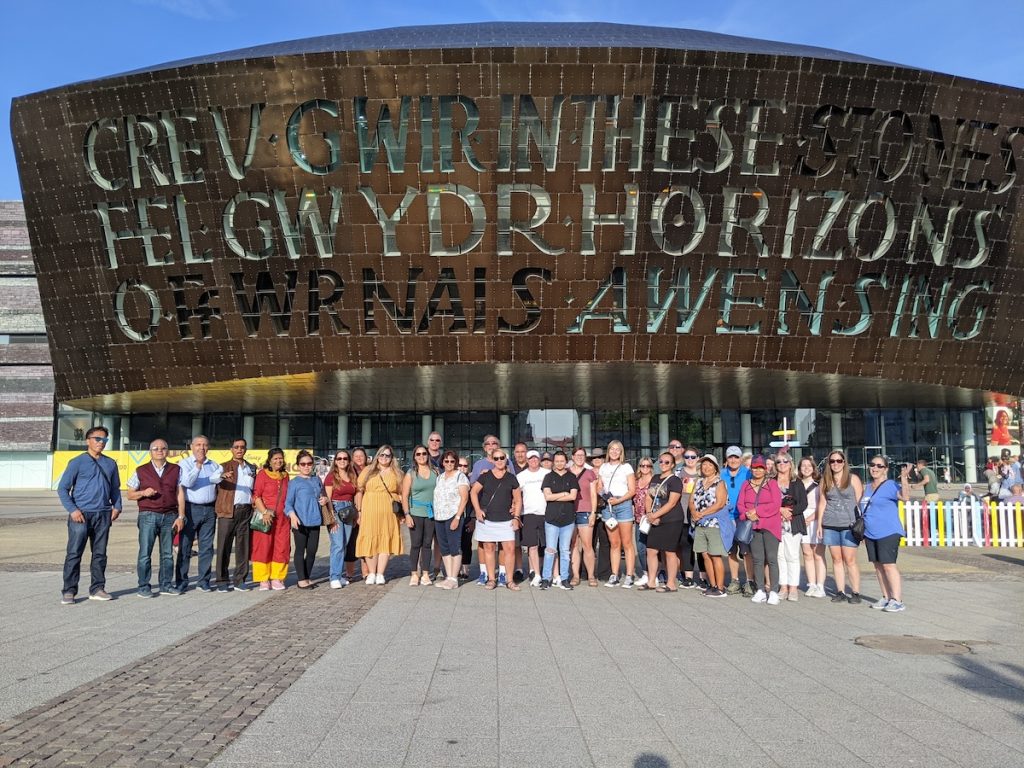
From the ancient to the elegant: next is Bath, all honey-coloured Georgian architecture and Roman history, so beautiful it feels like stepping into a Jane Austen novel (she lived here, so no wonder). Then comes the evening stop in Cardiff, and the contrast couldn’t be sharper. The Welsh capital is more of a practical overnight than a highlight, though the redeveloped Cardiff Bay is worth a wander, and you can rightfully claim you’ve spent a night in Wales.
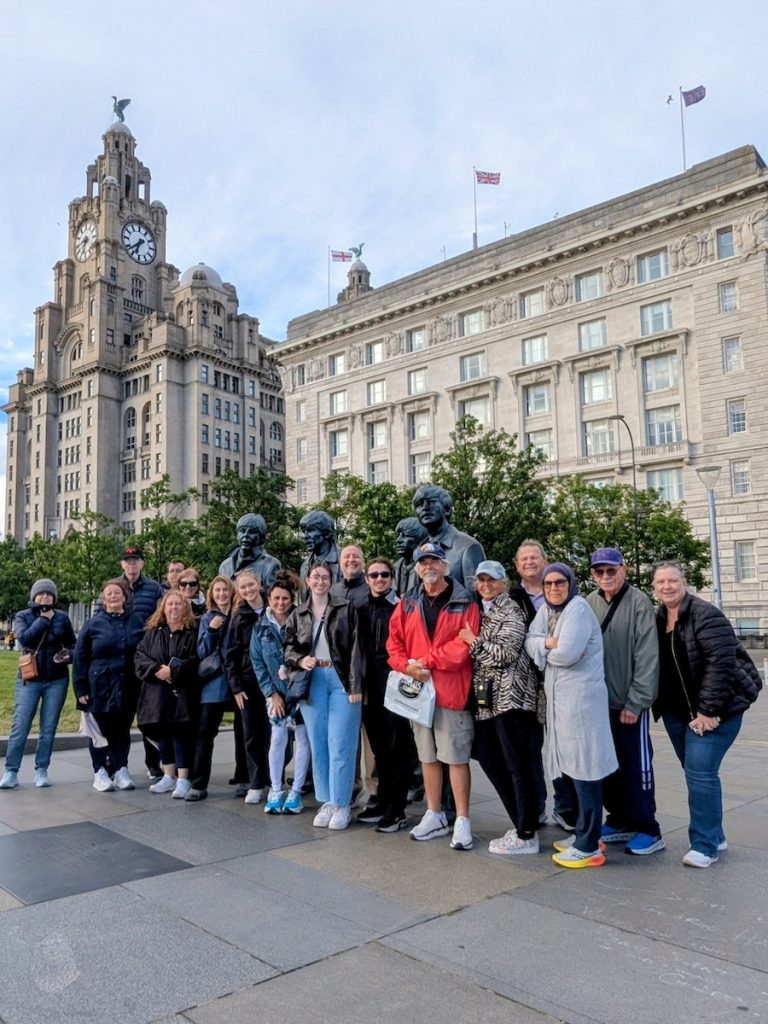
Three wildly different stops in a single day, and the theme carries into day two. First, Stratford-upon-Avon, with its Tudor timber buildings and the ghost of Shakespeare on every corner. Then north to Liverpool, where the coach playlist turns exclusively Beatles. Once an industrial powerhouse, heavily scarred by WWII, Liverpool today pulses with one of the best live music scenes in the country.
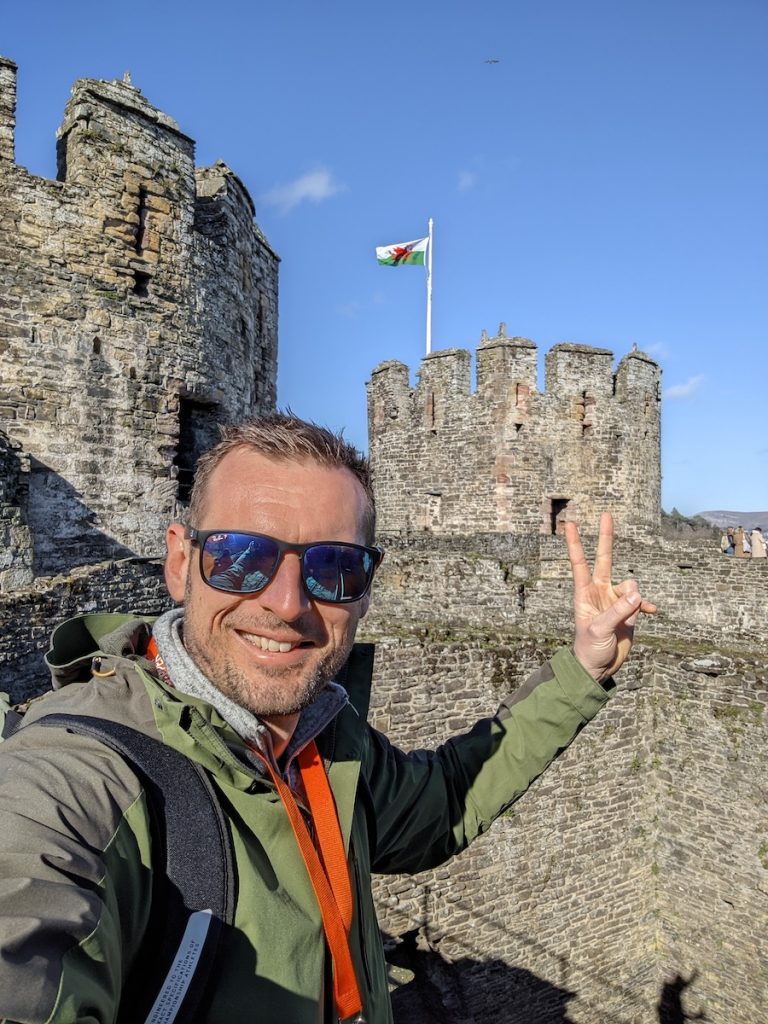
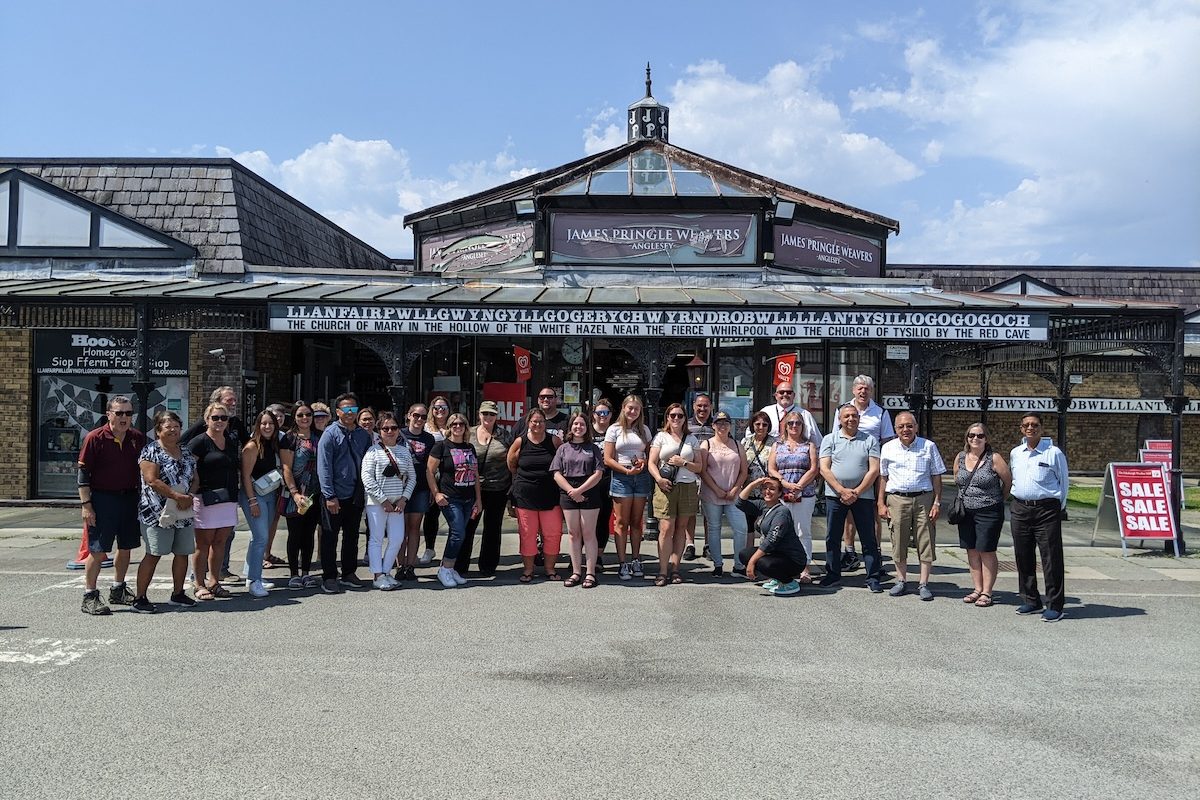
Day three dips back into Wales for Conwy, and this is one of those stops that catches guests off guard. When the group first spots its medieval castle and walls across the river, there’s an audible gasp. A final quick stop at the village with the longest name in Europe, Llanfairpwllgwyngyllgogerychwyrndrobwllllantysiliogogogoch (good luck), and then it’s onto the ferry at Holyhead.
What a whirlwind. Relax on the three-hour crossing, because there’s plenty more waiting on the Emerald Isle.
Chapter Two: Ireland — The Heart of the Tour
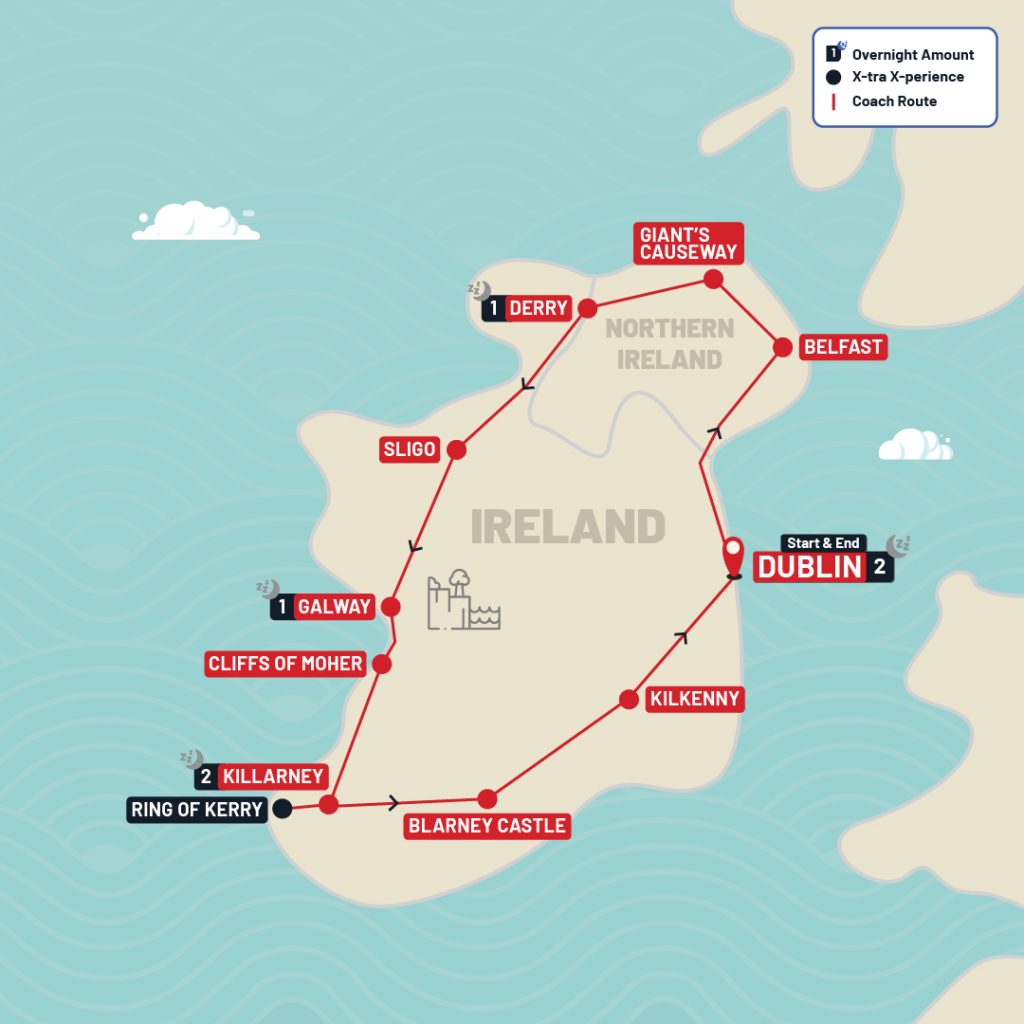
(Days 3–7: Dublin → Waterford → Blarney → Killarney → Ring of Kerry → Cliffs of Moher → Galway → Sligo)
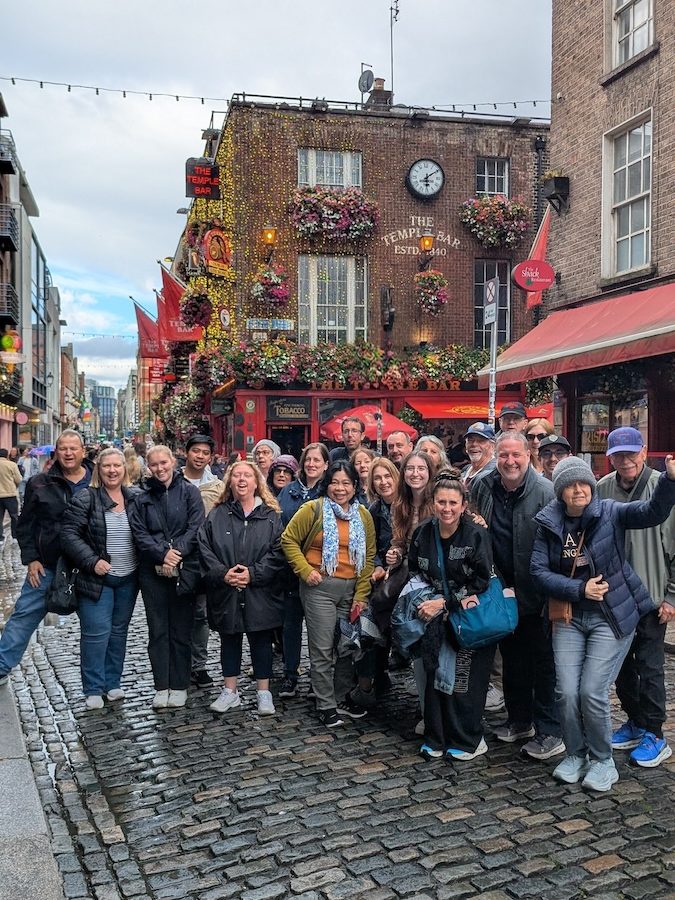
Ireland is the real heart and soul of this tour, and you feel it the moment the group walks into Temple Bar for the first time. Pubs packed shoulder to shoulder, live musicians in every corner, pints of Guinness passed over the crowd, and my group, strangers only two days earlier, suddenly grinning at each other like old friends. This is where the tour comes alive.
Whether you’re a Guinness fan or not, have a pint here. It genuinely does taste better in Ireland, and there’s no better place to test that theory than the Guinness Storehouse. But Dublin is more than pubs and pints.
It’s the capital of the Republic and the largest city on the island, well worth its two-night stop, with museums like EPIC, which tells the story of the Irish who emigrated across the world, offered as an optional or easily reached on your own. Whatever you do, don’t miss the Irish Music Evening. Food, live music, and Irish dancing: this is the night the group truly bonds, and mine still talk about it.
Leaving the city behind, the tour heads south and west, and the pace of discovery barely lets up. First is Waterford, Ireland’s oldest city, best known for the crystal that’s probably sitting in a cabinet at your parents’ house right now. They craft the trophies for golf, tennis, F1, and even the Times Square New Year’s ball.
Then comes the most touristic stop in Ireland: Blarney Castle. In peak summer the queues stretch long, all for the chance to kiss the famous Blarney Stone and receive the legendary “gift of the gab.” I’ve kissed it several times now and I’m still waiting, maybe I’ve overdone it. And it’s no simple peck, either.
After climbing the stairs to the top of the castle, you lie on your back, lean out over a gap in the battlements, and stretch down to kiss the stone while two staff members hold onto you so you don’t fall through the hole. It absolutely would not be allowed in Australia.
With the stone thoroughly kissed, it’s on to Killarney, the gateway to the highlight of the entire tour: the Ring of Kerry. This coastal drive through County Kerry, part of the Wild Atlantic Way, takes place on the free day as a paid optional, and I’ll be blunt: don’t skip it. It’s not just beautiful countryside, it’s a window into rural Irish life.
The day starts with a jaunting car ride (a horse and carriage) through Killarney National Park, past grazing cattle and deer with a stop by a castle. There’s a sheepdog demonstration too, and it’s genuinely mesmerising watching these dogs work an entire flock on nothing but the whistle commands of their handler.
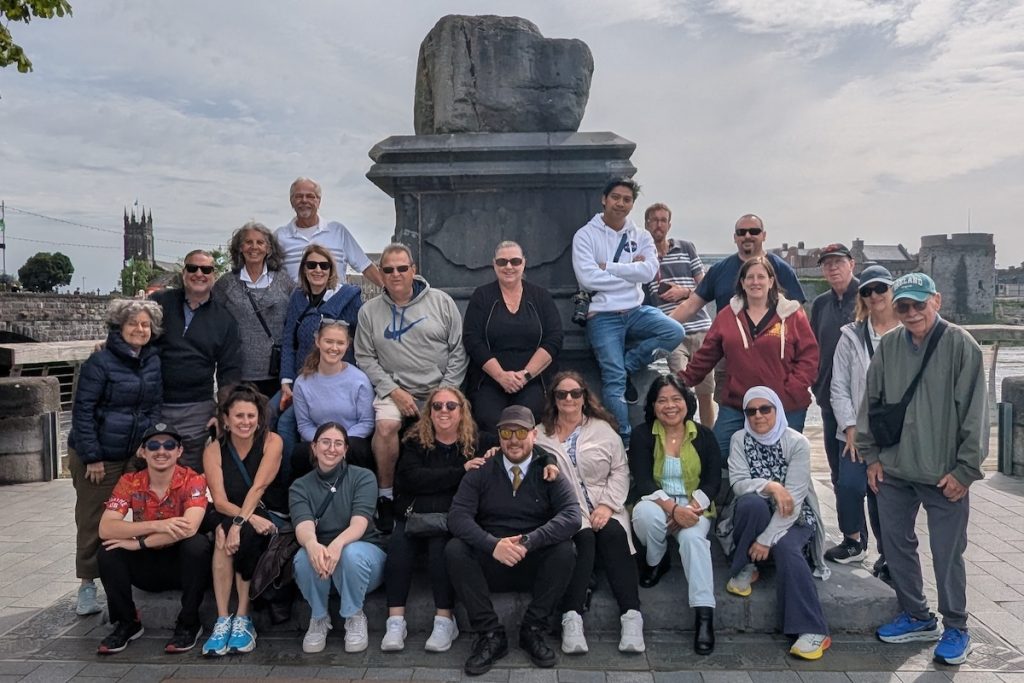
The last full day in the Republic keeps the momentum going. A stroll through Adare, officially Ireland’s prettiest village, and it doesn’t take long to see why. Then a quick photo stop in Limerick at the Treaty Stone and King John’s Castle. But the day belongs to the Cliffs of Moher.
Nothing quite prepares you for them. The land simply ends, falling 200 metres into the churning Atlantic, and the clifftop path delivers the kind of raw, windswept view that makes the whole group go quiet. Keep an eye out for puffins nesting in the rock face, and quietly pray the weather holds, because these cliffs are at their breathtaking best in the sunshine.
The Irish leg ends in Galway, and it’s the perfect note to finish on. It has the pubs and live music of Dublin’s Temple Bar but with a more genuine, lived-in feel. Less a tourist show, more the real thing. By the time the coach turns north toward Sligo and the border with Northern Ireland, the group isn’t a group of strangers anymore. There are inside jokes, singing on the coach, and a shared week of memories. That’s what Ireland does on this tour. That’s why it’s the heart of it.
With an Australian fella named Matt
They’d all booked a vacation
Travelled far from their nation
And now known as the family of Expat
Chapter Three: Northern Ireland — History and Legend
(Day 8: Derry → Giant’s Causeway → Belfast)
Cross the border into Northern Ireland and the atmosphere shifts. There are no passport checks, no stop, barely a sign, but you feel it. Many of you will remember a time when this place was constantly in the news, during a period known as the Troubles. The violence has long passed, but its legacy is still present in the landscape and in the conversations.
If you’re unfamiliar with the history, or simply curious why there are two countries on one island, here’s the brief version. Ireland was once part of the United Kingdom of Great Britain and Ireland, governed from Westminster. Some wanted independence; others wanted to remain in the union.
In the early 20th century, that disagreement escalated into conflict, and the island was ultimately partitioned into two states: an independent Republic of Ireland and Northern Ireland, which remains part of the UK. Decades of conflict followed between the two communities before the Good Friday Agreement brought peace in 1998.
The first stop is Londonderry, or just Derry, depending on who you’re speaking to, which tells you something in itself. You arrive mid-morning with time to walk the city walls, which are remarkably well preserved and let you trace the entire boundary of the old city centre on foot.
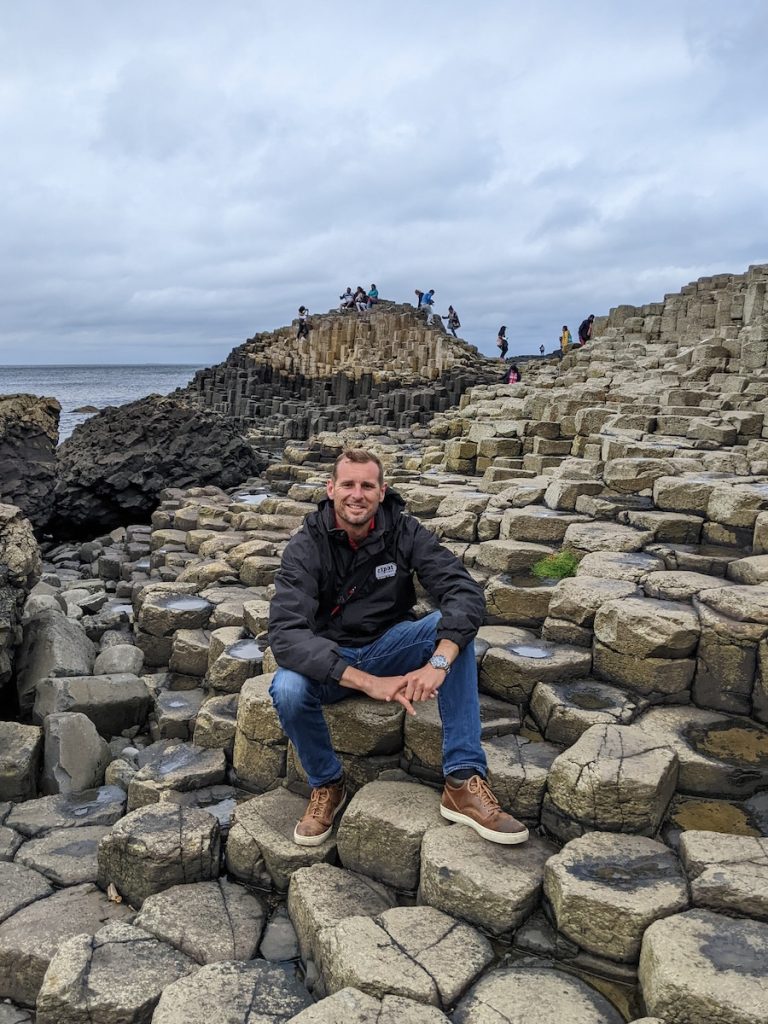
It’s not all heavy history, though. Irish folklore has it that the Giant’s Causeway was built by Finn McCool, a giant who wanted to reach Scotland to confront his rival, Benandonner. He hurled boulders into the sea to form a bridge, but on arriving, he discovered Benandonner was far larger than expected, fled home, and disguised himself as a baby.
When Benandonner came looking, he took one look at the “infant,” thought if that’s the child, how enormous is the father?, and bolted back to Scotland, tearing up the bridge behind him. You won’t spot any giants, but the 40,000 hexagonal basalt columns are a genuine marvel, and the coastal views alone justify the stop.
Then it’s on to Belfast, where the divisions are impossible to miss. Different communities flying different flags, and the so-called peace walls still standing, separating neighbourhoods from one another. Guiding us through it is Donal, a local guide who tells the story of this city through his own lived experience. He does it far better than I ever could, and it’s the single most valuable hour of the day.
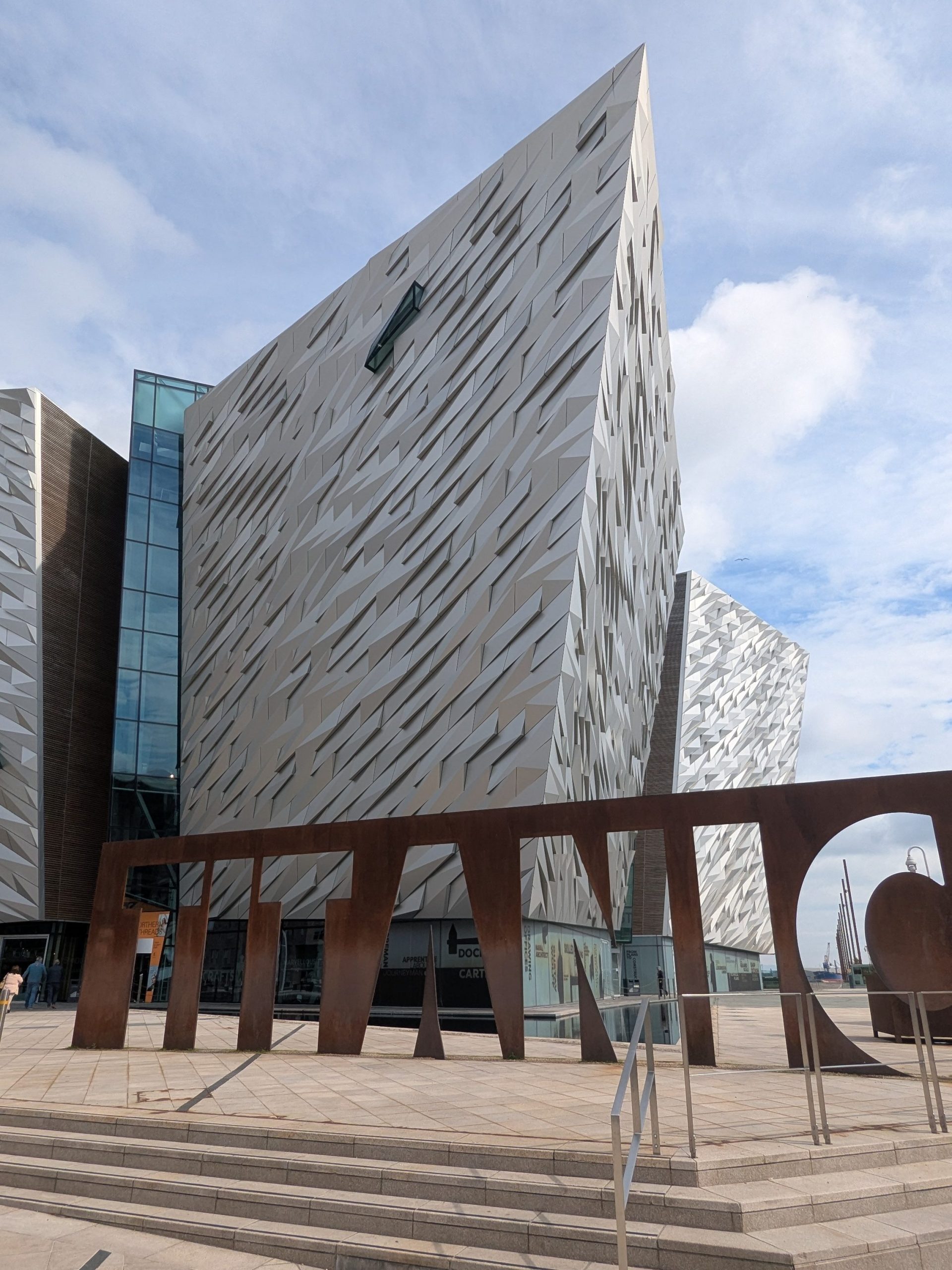
What Donal also does is show you Belfast’s other side. Beneath the weight of its past and its ongoing complexities, this is a city with real energy and plenty to explore. Not least the Titanic, which was built right here, and whose museum you’ll have the chance to visit the following morning.
Then it’s onto another ferry and back across to Britain. Time for Scotland.
Chapter Four: Scotland — Whisky, Lochs and Legends
(Days 9–11: Highlands → Glencoe → Loch Ness → Edinburgh)
The land of whisky, golf, hairy coos and the Loch Ness monster. For me, Scotland is the highlight of the tour, and it announces itself the moment you roll off the ferry with bagpipes blaring through the coach speakers. Genuine goosebumps, every single time.
From there it’s north, a four-hour run toward the edge of the Highlands. Naturally, that calls for a break, and there’s really only one appropriate place to stop. Whisky runs through Scottish identity, and Jackton Distillery makes for a fine introduction. Whether you’re a whisky drinker or not, a wee dram is the only proper way to toast your arrival.
The hotel that night is no glossy chain. It’s rustic, old-school, and out in the countryside, and guests tend to love it precisely for that. It fits the place. It’s also the ideal launchpad for what comes next.
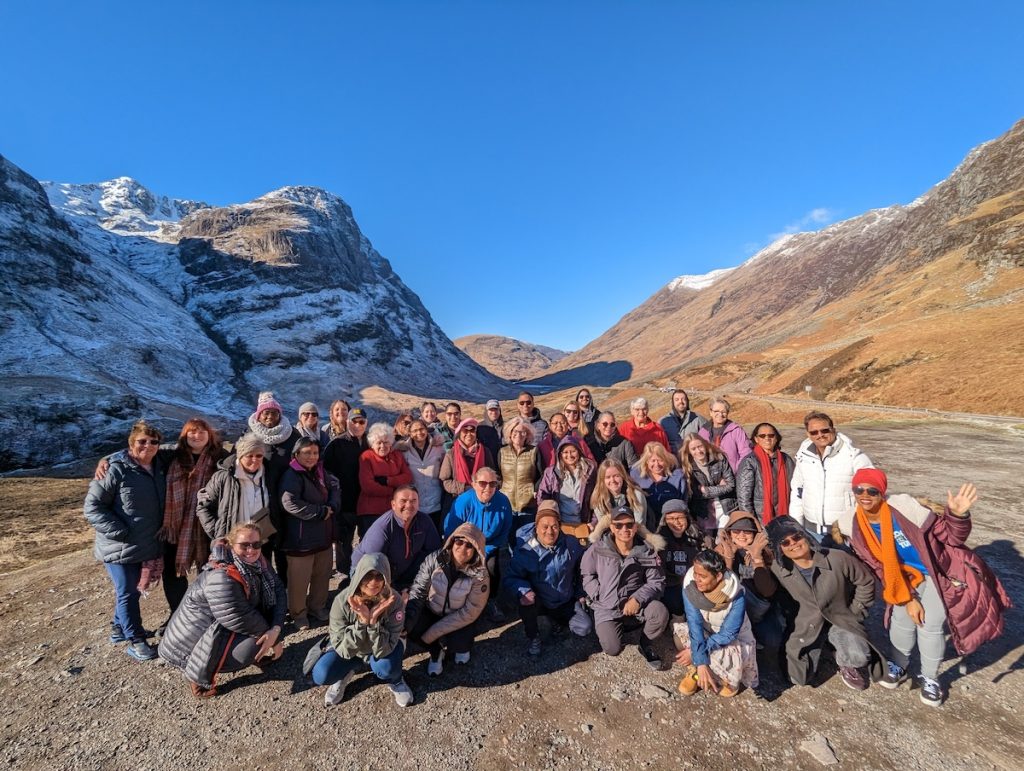
Because the Highlands drive day wastes no time. Glencoe arrives early and hits hard. Brooding mountains rising straight from the valley floor, weather rolling through in minutes, the kind of landscape that silences a coach full of people mid-conversation. There are multiple photo stops. Take every one of them.
But the day belongs to Loch Ness. You explore it from Fort Augustus, and you’ve got a choice: join the cruise and go monster hunting properly, or skip it, take your time in town and scan the shoreline for Nessie yourself. Either way, standing beside that vast, dark, impossibly deep stretch of water, you start to understand why the legend has held for centuries.
The road to Edinburgh has a few more tricks up its sleeve. There’s the Commando Memorial, where you can pay respects to the UK’s special forces and catch a glimpse of Ben Nevis, Britain’s highest peak. And if you’re lucky, your tour leader will track down a field of Highland cattle. Long-haired, unbothered, permanently photogenic, and known affectionately as hairy coos. Say hello.
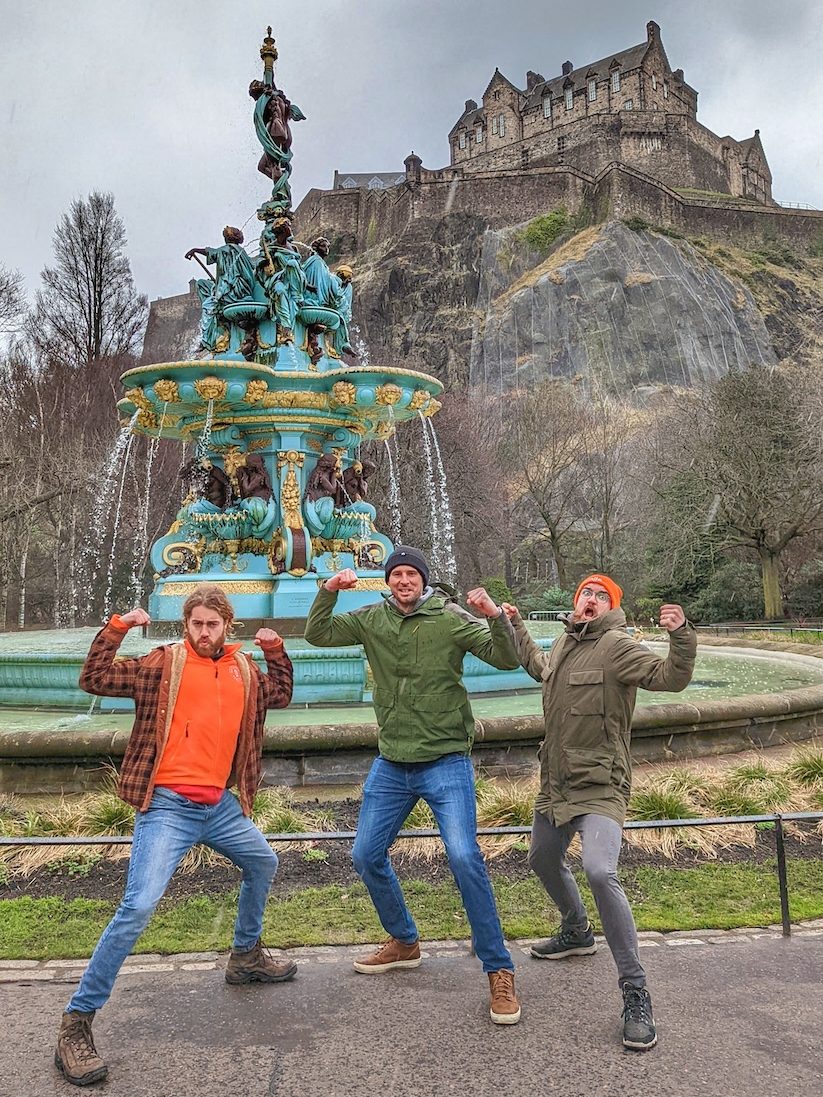
You arrive into Edinburgh in the evening, and I hope it floors you the way it still floors me. Every visit, without fail. Monuments, extraordinary architecture, Edinburgh Castle looming over the skyline, and the Royal Mile humming with street performers. It’s one of the great European cities.
That first night is only a taster after the long Highlands drive. A quick orientation with your tour leader, then an included dinner in one of the city’s countless pubs.
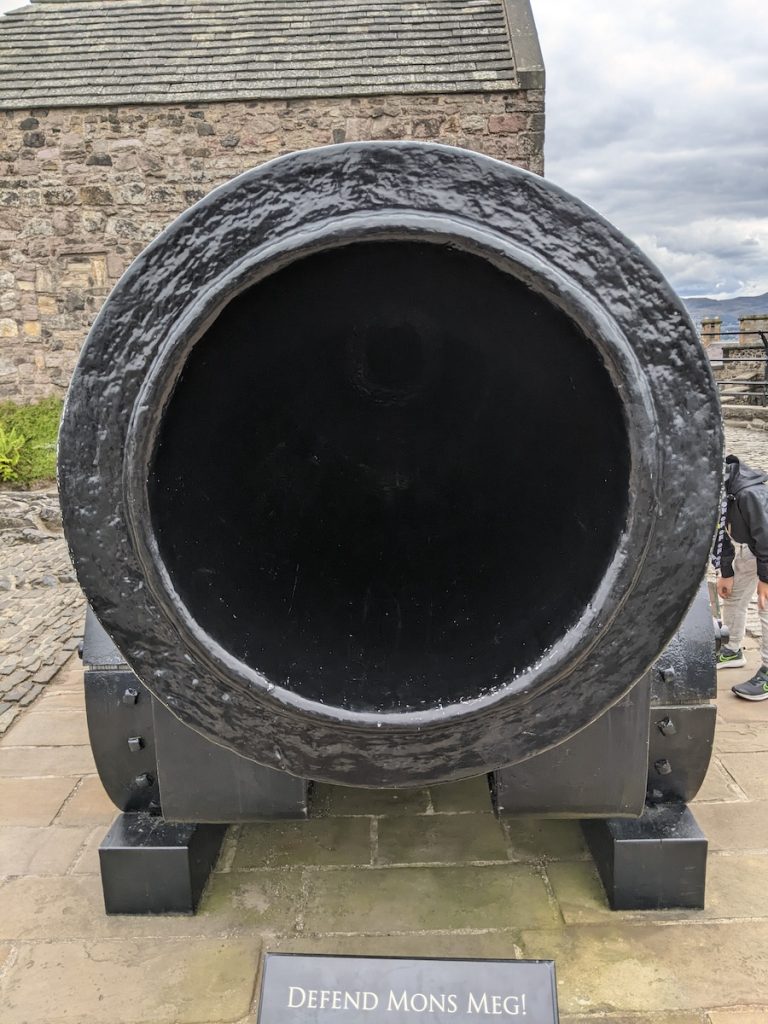
The next day is yours. Explore independently or take a guided optional, but whatever you do, visit Edinburgh Castle. It’s the finest in the UK and the beating heart of the city. Inside you’ll find sweeping viewpoints over the rooftops, ancient cannons still trained outward (it was a fortress, after all), a genuinely fascinating military museum, and the Scottish crown jewels.
One thing worth knowing about the castle, and Edinburgh generally: this city is steep. The castle sits atop an extinct volcano and everything else has grown around it, so the Old Town climbs relentlessly upward, threaded with staircases and closes. Comfortable shoes, and take your time.
For your final evening, I’d strongly recommend the Heart of Scotland show. It’s a completely different animal to the Irish music night. Ballads, bagpipes, and your chance to face down a plate of haggis. Scottish cuisine doesn’t have the best reputation abroad, and yes, you really can buy a deep-fried Mars bar in Edinburgh, but the Torphichen Inn serves proper, traditional fare with a few drinks thrown in. The perfect way to raise a glass and say slàinte mhath to your time in Scotland.
Chapter Five: The Return to England — Castles and Spires
(Days 12–13: Alnwick Castle → York → Cambridge → London)
With Scotland done and London looming, you’d be forgiven for assuming the highlights are behind you. They aren’t. These final two days hold their own against anything that came before.
Crossing back into England doesn’t produce the same cheer as arriving in Ireland or Scotland. But the moment Alnwick Castle comes into view, the mood in the coach lifts anyway.
If you’re not from the UK, there’s a good chance you’ve never heard of it. Alnwick is overshadowed by the Tower of London and Windsor, and that’s a genuine injustice, because it may well be the finest castle you visit on this entire tour.
Part of the reason is that it’s still a living castle. Edinburgh Castle and the Tower are full-time museums. Alnwick is the winter residence of the Percy family, thrown open to visitors during the summer months while they’re elsewhere.
There are two halves to a visit. The castle itself gives you access to the state rooms, still furnished, still lived in. Then there are the grounds, which come with an unexpected claim to fame: this is where Harry Potter’s broomstick flying lessons were filmed. You can even take a lesson yourself. It’s exactly as ridiculous and as fun as it sounds, and I’ve yet to see a group turn it down.
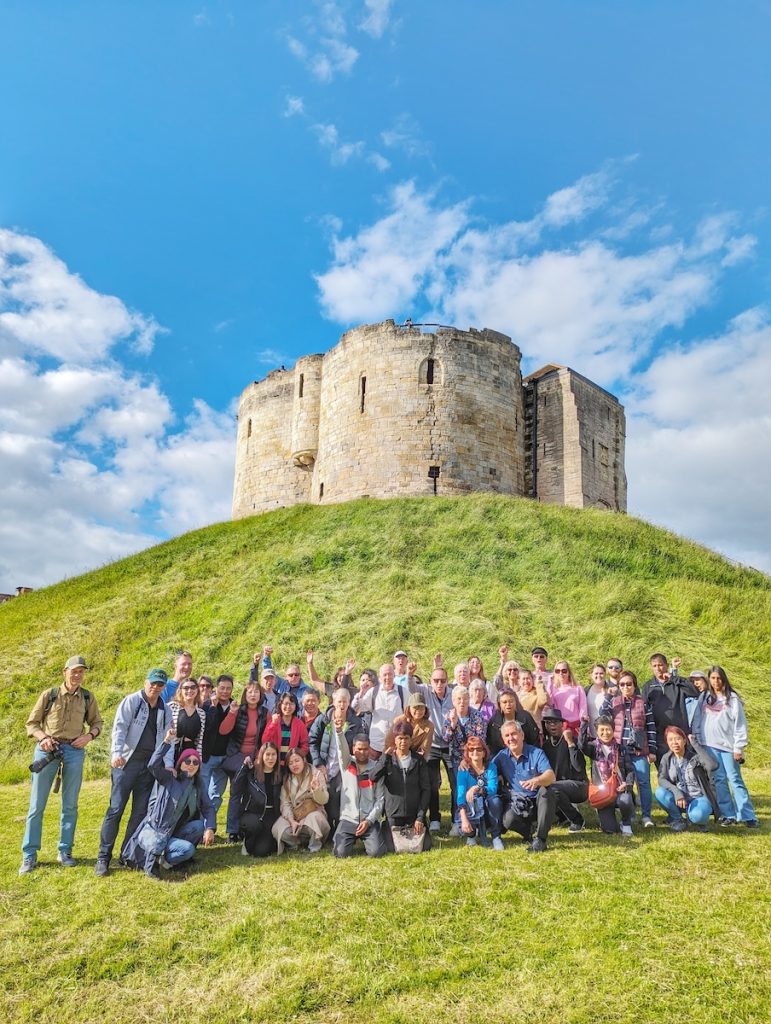
From there it’s on to York, and the tour saves one of its best cities for near the end. You can walk the medieval walls, which still ring the old centre, climb Clifford’s Tower for the view, and squeeze through the Shambles, a narrow lane of leaning timber-framed buildings so perfectly preserved it feels staged. Above it all sits York Minster, the largest Gothic cathedral in northern Europe. The farewell dinner happens here, in a proper English pub, and it always lands the same way: a room full of people who were strangers twelve days ago, now swapping contact details and promising to visit each other.
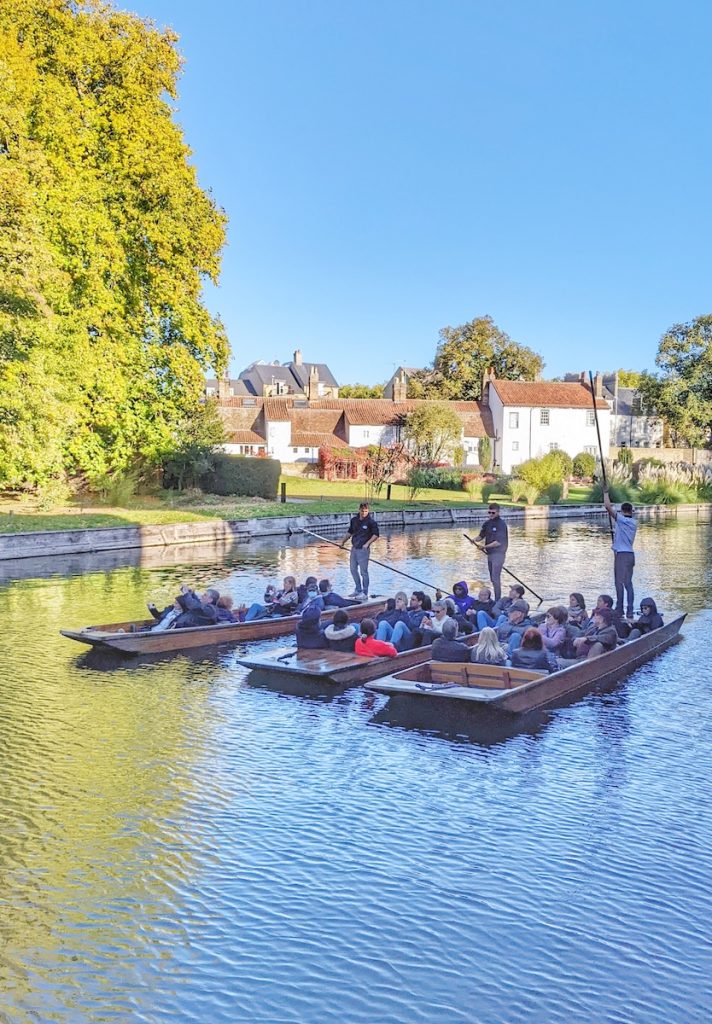
The final morning brings one last treat. Cambridge, and an included punting trip along the River Cam, gliding past the colleges with someone else doing the hard work with the pole. Then free time to wander the university town before a last pint with the people you’ve spent nearly two weeks travelling alongside.
And then London. The coach pulls in, the circle closes, and it’s over. You started in this city knowing no one. You leave it with a group chat that, in my experience, stays busy for years.
Optional Excursions: What’s Worth It
The optional excursions add real cost to the tour, so it’s worth knowing which ones deliver. The good news is that every optional on this tour has something to offer. But if your budget won’t stretch to all of them, here’s how I’d prioritise, having led this tour many times and done every one of these myself.
Must Do
- Irish Music Evening — A night out at the Merry Ploughboy Gastro Pub with great food and genuinely fun entertainment, including live music and Irish dancing. This is where the group truly bonds.
- Ring of Kerry — Not just beautiful scenery, but photo stops, little villages, a horse and carriage ride, and sheepdogs rounding up the flock. The best day on tour.
- Heart of Scotland — A different experience to the Irish evening. This one leans into ballads and Scottish folklore in a historic pub, with great food, included drinks, and the chance to try haggis.
- Alnwick Castle & Gardens — You can choose to do just the castle or just the gardens, but for the full experience I’d do both.
Highly Recommend
- Ireland’s Identity — The best way to understand the Irish story. A guided visit to Glasnevin Cemetery, where many of Ireland’s national heroes are buried, EPIC the Irish Emigration Museum, which tells how the Irish ended up all over the world, and the General Post Office, site of the 1916 Easter Rising.
- Whiskey & Guinness — Two parts. First, Pearse Lyons Distillery, set inside an old church. The Irish are known for their faith and their fondness for a drink, so I suppose merging the two makes sense. Even if you don’t drink whiskey, seeing the repurposed church is the real highlight. Then the Guinness Storehouse, Dublin’s most popular attraction, finishing with an included pint on the rooftop bar overlooking the city.
- Stonehenge — The only reason to skip it is if you’ve been before.
- Shakespeare’s Birthplace & Afternoon Tea — Stratford-upon-Avon is a lovely town, best known as Shakespeare’s birthplace, with his childhood home sitting right on the high street. Even if you’re no fan of the man himself, stepping inside a house that’s been standing for 500 years is remarkable. Then relax over sandwiches and scones and settle the great debate: jam then cream, or cream then jam.
- Titanic Museum — The highlight of Belfast, dedicated to the world’s most famous ship. Learn about its construction, its tragic maiden voyage, and the aftermath, in the very city where it was built.
Great But Not Essential
- Beatles Story & Museum — Liverpool is the home of the Beatles, so their story appeals to many guests. But if they’re not your thing, skipping it buys you more time to explore the city.
- Tales of Galway — Galway is famous for its lively pub scene, and this excursion recreates it with an interesting fellow named Brian. Completely unscripted, you enjoy a pint while Brian shares his stories and his musicians handle the rest.
- Loch Ness Cruise — A relaxing cruise out onto the loch with live commentary on the history of the monster, and the likely truth behind the legend. Worth it if you want to get out on the water and hunt for Nessie yourself.
- Sights of Stirling — If you’ve seen Braveheart, you know William Wallace, the real Scottish hero who led an uprising against English rule. His monument stands on a hill overlooking the famous battlefield. Be warned though, it’s built like a castle with narrow, winding staircases, so if stairs aren’t your friend, sit this one out.
- Edinburgh: Conquer the Capital — A guided walk around Edinburgh with your tour leader, plus Edinburgh Castle. Here’s the key thing: this pairs naturally with Sights of Stirling. If you’re doing Stirling, take this too. If you’re not, you’re better off exploring Edinburgh independently.
Best of UK & Ireland vs the 7-Day Options
I know thirteen days can be a serious commitment, especially for my American friends working with limited vacation time. If you’d rather focus on just one side of the Irish Sea, Expat Explore runs two shorter seven-day tours that cover the same ground at a gentler commitment.
- The Irish Explorer starts and finishes in Dublin and covers essentially the same Irish highlights as the full tour, just in reverse. It skips Waterford, but adds a few stops the longer tour misses: Kilkenny, Bunratty Castle, and a full overnight in Galway rather than passing through.
- The Great Britain tour starts and finishes in London and mirrors the British half of the full itinerary, again in reverse. There’s no stop at Alnwick, but it makes up for it with Jedburgh, Gretna Green, and the Lake District.
So which should you choose?
- Choose the Irish Explorer if Ireland is the dream: the Guinness, the Ring of Kerry, the Cliffs of Moher, and the pub culture that gives this region its warmth. It’s ideal if you’ve seen Britain before, or if the Emerald Isle is what’s been calling you.
- Choose the Great Britain tour if you’re drawn to the castles, the Scottish Highlands, and the historic cities of England and Scotland, and Ireland can wait for another trip.
- Choose the full Best of UK & Ireland if you want the complete picture, all five countries, and the sense of a single journey building from London through Ireland, Scotland, and back. It’s also the smart choice if this is a once-in-a-lifetime trip and you’re not sure when you’ll return.
One important note: because these are separate tours rather than segments of the 13-day itinerary, they aren’t a straight “first half / second half” split. Routes, stops, and even the direction of travel differ, so check the specific itinerary for each rather than assuming it matches the corresponding days of the full tour.
Accommodation Standards
For an Expat Explore tour, the hotels on this route are some of the best in the company’s range. Guests are consistently happy with them, and often pleasantly surprised.
Expect mostly three-star hotels, a mix of reliable chains like Clayton, ibis and Novotel alongside a few independent operators. Depending on the stop, you might be central or a little further out, but where hotels sit outside the city centre there’s always good public transport to get you in.
Most also have their own bar, which turns out to be one of the quiet secrets of a good group tour. There’s no better way to cap off a day of sightseeing than a nightcap with your travel companions without anyone having to venture back out.
Occasionally, a hotel is a highlight in its own right. The Clayton in Sligo looks like a grand country mansion as you pull up the drive, all imposing stone and sweeping grounds. The twist is that it was once a mental asylum. It makes for a memorable night’s stay and an even better story to tell when you get home.
If you’ve done an Expat Explore tour on the continent, you may remember the mild disappointment of a room with no tea and coffee facilities. Not here. This is the land of tea drinkers, so a kettle and the usual supplies come as standard.
Breakfast is a step up too. Continental tours tend to serve, well, a continental breakfast, but here you get the full cooked offering. British cuisine may not have the world’s finest reputation, but no one does bacon and eggs quite like the British.
The one genuine drawback is air conditioning, which isn’t standard in this part of Europe. For most of the year that’s no issue at all, since it simply isn’t needed. But if your tour happens to land during a summer heatwave, a few guests do find the rooms a little warm.
Tour Pace & Physical Considerations
Like any Expat Explore tour, this one aims to see as much as possible. This is not Expat Sit Around and Do Nothing. But of all their itineraries, I find this one strikes the best balance between sightseeing and genuine moments of rest.
There is a fair bit of ground to cover, of course. Fitting both Ireland and Britain into 13 days means some solid driving days, and mornings tend to start early, with breakfast around 6:30 or 7:00am for a 7:30 or 8:00am departure.
But the drives themselves are one of the underrated pleasures of this tour. Rather than pulling into motorway service stations, the coach breaks in smaller towns and villages, and the routes roll through some genuinely beautiful countryside. It makes the travel part of the experience rather than dead time between stops. Here, the journey really is as much a part of it as the destination.
There are plenty of one-night stops, and normally I’d flag that as a downside. On this tour, it isn’t. Because the region is so compact, you’re never driving far to reach the next destination, so a single night is enough to see a place without feeling rushed.
It’s the opposite of my advice for continental tours, where I steer people toward itineraries with mostly two-night stays. Here, the places that genuinely need more time, Dublin and Edinburgh, both get two nights, giving you an afternoon plus a full free day to explore properly.
The pace on foot is manageable too. There are no long, drawn-out walking tours, so you won’t be marched to exhaustion, and you’re given plenty of free time to explore at your own speed. The only real physical challenge comes from the occasional cobbled street, and even those are the exception rather than the rule.
Is This Tour Right For You?
After leading this tour many times, I’ve got a good sense of who steps off in London on day 13 absolutely buzzing, and who finds it isn’t quite their pace. Here’s my honest take.
You’ll love this tour if:
- It’s your first trip to the UK and Ireland. You’ll see all five countries and hit the headline sights without spending weeks planning ferries, hotels, and driving routes on the wrong side of the road.
- You’re travelling solo. This tour builds a tight-knit group faster than almost any other, thanks to the pub culture, the music evenings, and the shared ferry crossings. You’ll rarely eat dinner alone unless you want to.
- You want variety over depth. Five countries in under two weeks means you’re sampling the best of each rather than settling into one. If that breadth excites you rather than tires you, this is your tour.
- You love history, castles, and a good pub. This itinerary is practically built around all three.
- You enjoy the journey, not just the destinations. The scenic drives and small-town stops are a genuine part of the experience here.
You might want to look elsewhere if:
- You want to explore in real depth. One night in most places means you’re seeing the highlights, not living like a local. If slow travel is your thing, you may find the pace brisk.
- You need luxury. These are comfortable three-star hotels, not five-star retreats.
- Early mornings are a dealbreaker. With 6:30am breakfasts on driving days, this tour rewards early risers.
- You dislike group travel. Groups can reach 40-plus people. If a fixed itinerary and travelling alongside others sounds draining rather than fun, independent travel may suit you better.
- Mobility is a serious concern. Cobbled streets, castle staircases, and the walk up to Edinburgh Castle can be challenging, though you can always opt out of the more demanding excursions.
If you recognised yourself in that first list, you’re going to have the time of your life. For more on the company behind this tour, read my full Expat Explore Review covering their range, booking process, and what to expect as a first-time customer.
Frequently Asked Questions
For a full breakdown of how to time your booking, use early bird deals, and stack discounts, read my guide on how to get the best price on group tours.
Ready to join?
Use promo code TOURLEADERSJOURNAL for 5% off any Expat Explore tour.
Final Verdict
Thirteen days. Five countries. Ancient stone circles, cliff-top castles, whisky distilleries, Guinness on tap, the Loch Ness monster, and a village name no one can pronounce.
I’ve led a lot of tours, and the Best of UK & Ireland tour remains one of my favourites to run, because it never gets old watching a coach full of strangers turn into a group of friends somewhere between a Dublin pub and a Scottish distillery.
What makes it stand out isn’t any single castle or coastline. It’s the sheer variety. Few tours anywhere pack this much contrast into under two weeks: the ancient mystery of Stonehenge, the Georgian elegance of Bath, the raw drama of the Cliffs of Moher, the weight of history in Belfast, the wild beauty of the Highlands, and the medieval charm of York. Every single day feels different from the last, and that’s the whole point.
Is it perfect? No tour is. There are early mornings, plenty of coach time, and one-night stops that leave you wishing for more. If you want luxury or slow, deep immersion in a single place, this isn’t the tour for you. But if you want to experience the very best of five countries, guided by someone who handles the logistics so you can just enjoy it, all while making friends you’ll keep long after the trip ends, this delivers in a way few tours can.
After leading it many times, I can tell you the people who book it rarely regret it. More often, they’re already planning their next Expat Explore adventure before the farewell dinner is over.