Ultimate Greece Travel Guide: Everything You Need to Know Before Your Trip
This Greece travel guide covers everything you need to know about one of the world’s most captivating destinations. As someone who has led countless tours through this magnificent country, I’m often asked: What makes Greece so special? My answer is simple—it offers something for everyone.
As the birthplace of Western civilisation, Greece boasts an incredible array of ancient marvels for history enthusiasts. Food lovers will delight in what’s ranked as the world’s second-best cuisine and one of the healthiest. The country showcases a unique culture and identity that Greeks proudly celebrate at every turn.
From the dramatic mountainous countryside to the crystal-clear waters surrounding hundreds of islands, Greece delivers stunning natural beauty. Whether you’re seeking vibrant nightlife or peaceful beach relaxation, travelling on a shoestring budget or indulging in luxury escapes, Greece accommodates every style of traveller.
This comprehensive Greece travel guide provides everything you need to understand Greece’s fascinating history, vibrant modern society, and practical Greece travel tips. While not exhaustive, it offers a solid foundation for Greece vacation planning. For more detailed Greece travel guides, check out my in-depth articles on Athens, Meteora, Santorini, and Mykonos.
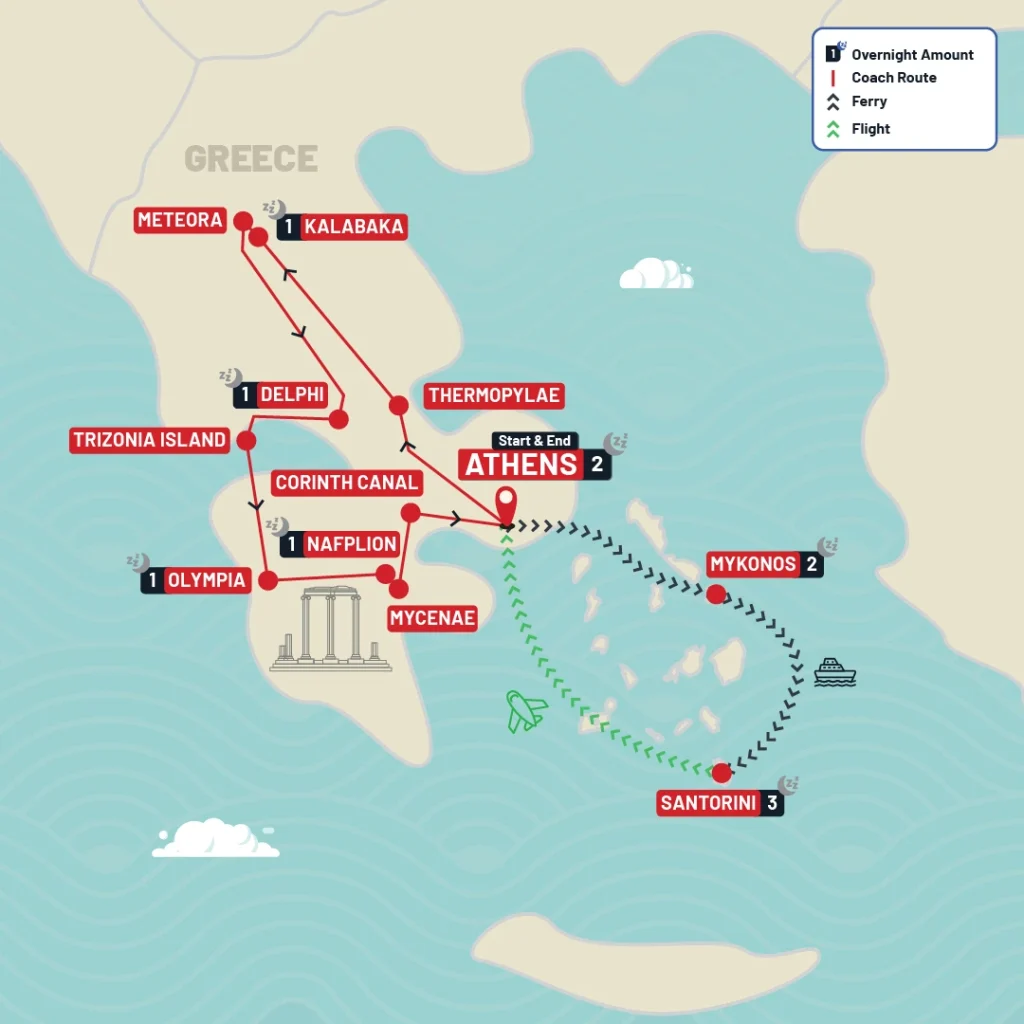
Ready to explore Greece without the planning stress?
I’ve partnered with Expat Explore to offer you an incredible Greece tour experience.
Use my exclusive promo code ‘TOURLEADERSJOURNAL‘
to save 5% on your booking!
Greece Geography: Location and Landscape
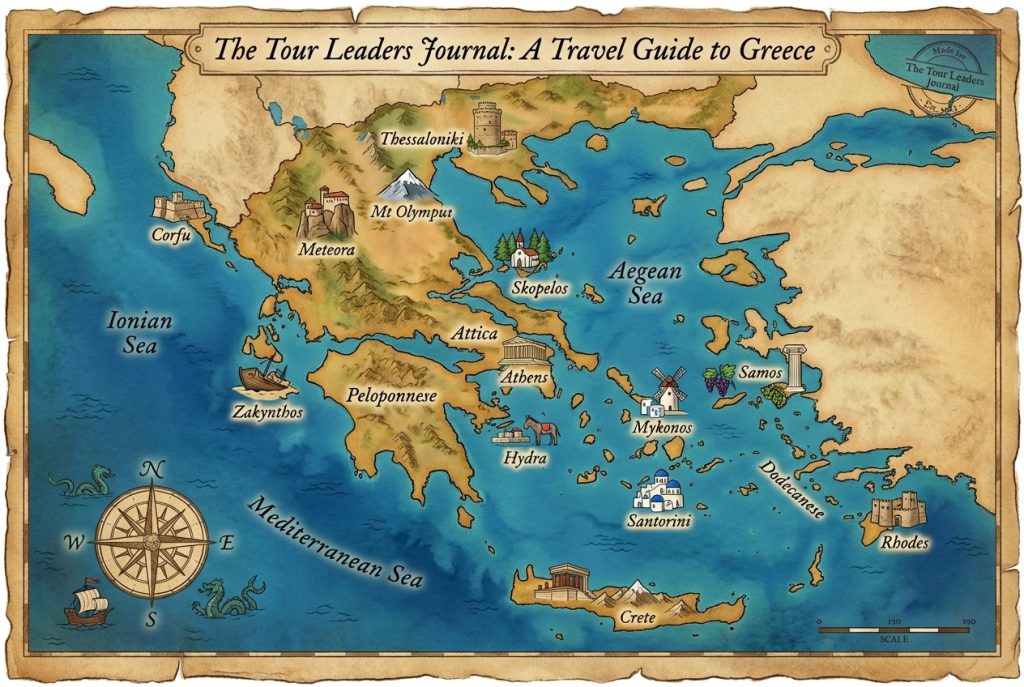
Located in southern Europe along the Mediterranean, Greece sits beautifully wedged between the Ionian Sea to the west and the Aegean Sea to the east. The country shares land borders with Albania, North Macedonia, Bulgaria, and Turkey to the north.
Greece’s territory resembles an octopus, with the mountainous mainland peninsula forming the head and approximately 1,400 islands extending like tentacles. The mainland’s highest peak is Mount Olympus, reaching 2,918 meters (9,572 feet)—the mythological home of the ancient Greek gods.
With a total population of 9.8 million, most Greeks reside in the capital city of Athens (3.1 million—about one-third of the country’s population) and Thessaloniki (749,000), the only other major city. Interestingly, Melbourne, Australia, claims the third-largest Greek population worldwide. It’s a running joke in Greece that everyone has a cousin in Australia!
Brief History of Greece: From Ancient Civilization to Modern Nation
Our Greece travel guide wouldn’t be complete without discussing its history. While Greece’s complete history deserves volumes, understanding modern Greece requires knowing key historical periods:
Minoan Civilization (3100 BCE)
The Minoans were a Bronze Age civilization based on Crete, regarded as Europe’s first civilization. Their society ended after a catastrophic volcanic eruption on Santorini.
Mycenaean Civilization
The Mycenaeans succeeded the Minoans and established the mainland’s city-states (polis). During this era, Greek mythology developed, and the legendary Trojan War would have occurred if the tales are true.
Archaic Period
After a 300-year dark age, Greece was reborn with the arrival of the Dorians (who settled the Peloponnese) and the Ionians (who settled the mainland and islands). Greek culture spread across the Mediterranean as city-states established colonies. This period saw the Greek Alphabet take its current form and witnessed the establishment of both the Olympic Games and the Oracle at Delphi.
Classical Period
A threat from Persia united Greece’s two great powers—Athens and Sparta. Athens defeated the Persians at Marathon. Ten years later, 300 brave Spartans sacrificed themselves at Thermopylae, allowing Athenians to escape to their ships, regroup, and sink the Persian fleet in the Bay of Salamis.
Athens entered its golden age as ruler of the Delian League, amassing wealth to build the Parthenon and establishing schools of philosophy, science, and mathematics. However, this led to the 30-year Peloponnesian War with Sparta, leaving both sides exhausted despite Sparta’s victory.
Hellenistic Period
Weakened by war, the Greek city-states fell under Macedonian dominance led by King Philip. When Philip was murdered, his son Alexander (the Great) took the throne. He led the Greeks against Persia, conquering their empire along with Egypt and marching as far as India, spreading Greek culture throughout the Near East.
Roman Greece
Fractured after Alexander’s death, Greece was conquered by Rome. However, Romans adored Greek culture, philosophy, and art, and Greece thrived during this period. You could say the Romans became more Greek than the Greeks became Roman.
As the empire expanded, it split into two, with a second capital established at Byzantium (renamed Constantinople). This coincided with Christianity’s adoption. Greeks fell under the Eastern Empire’s church—the Orthodox Church. When Rome fell, this Eastern Roman (Byzantine) Empire continued for another 1000 years.
Ottoman Period (1453–1821)
Ottoman Turks captured Constantinople in 1453 and ruled Greece for 400 years. Despite their grand church, the Hagia Sophia, being converted into a mosque, the Greek Orthodox Church kept Greek identity alive.
Greek Independence and Modern Era
The Greek War of Independence began in 1821, leading to the establishment of a Greek state. With no royal family of their own, the Greeks were given Otto of Bavaria as king. Hostilities continued over the next century as Greeks pushed into Ottoman territory.
After World War I, Greeks saw an opportunity to reclaim Constantinople in what was called the “Great Idea.” Despite early success, it ended catastrophically in genocide as the Turks reorganised. Communities were devastated as population exchanges occurred under the 1923 Treaty of Lausanne, which confirmed the current Greek-Turkish borders.
Greek Politics and Government
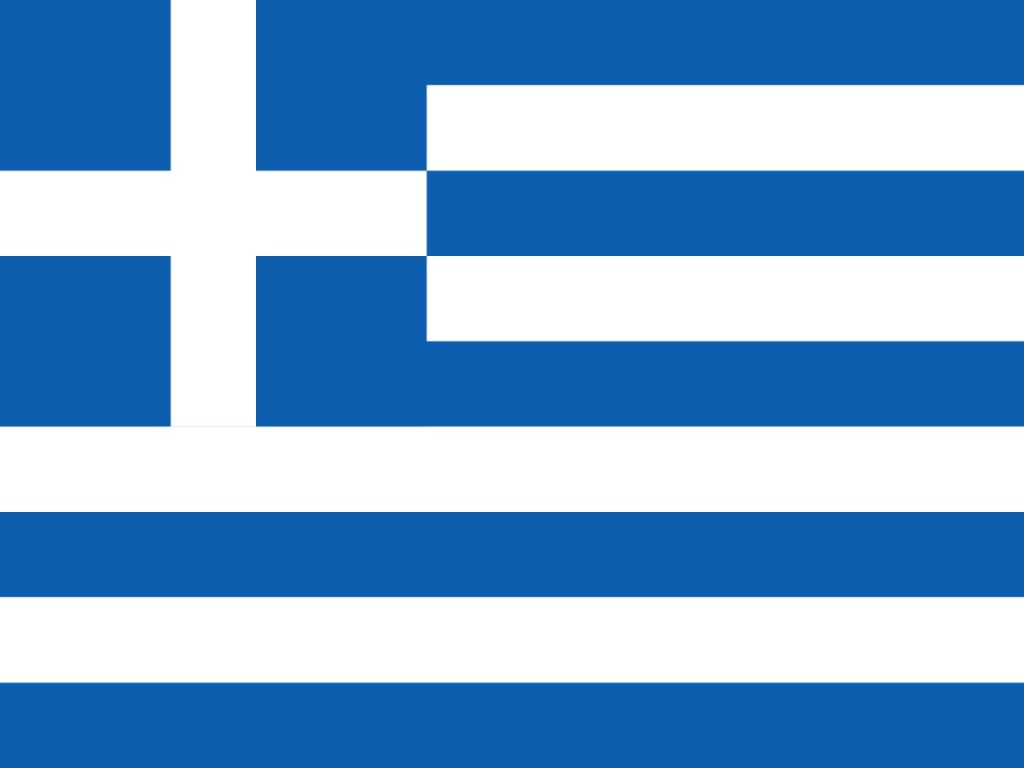
Today, Greece is formally the Hellenic Republic, a unitary parliamentary republic with a president as head of state and a prime minister as head of government. President Konstantinos Tasoulas was elected in 2025, though this is largely a ceremonial role.
Real power resides with the prime minister, currently Kyriakos Mitsotakis, who was reelected with a large majority in 2023. He leads the centre-right New Democracy party and is popular for steering Greece out of the financial crisis and maintaining strict border controls.
Greeks are highly politically active, with frequent protests in Syntagma Square in front of the parliament building. When travelling to Greece yourself, you may notice police buses and officers in riot gear when visiting Athens, but there’s no cause for concern as a tourist.
Greece is a founding member of the United Nations, joined NATO in 1952, became a European Union member in 1981, and joined the Schengen zone in 2000.
Greek Economy: Tourism, Shipping, and Recovery
Greece joined the Eurozone in 2001, replacing the drachma with the euro. The Greek one-euro coin features an owl design inspired by Athenian coins from 2,500 years ago.
Tourism is Greece’s primary industry—it’s the world’s 10th most-visited country. Shipping is another major industry, with the Greek merchant navy controlling 16% of the world’s fleet and operating the most tankers and bulk carriers globally. Agricultural production focuses on cotton (Greece is the EU’s biggest producer), olives, and olive oil.
The Greek Financial Crisis and Recovery
You’ve likely heard of the Greek financial crisis following the 2008 global economic downturn. Essentially, the Greek government had borrowed extensively for public sector expansion and large infrastructure projects, particularly the 2004 Olympics. As the global economy declined, Greece appeared likely to default on its debts.
This threatened wider implications for the Eurozone, so other member states (notably Germany) and the IMF bailed Greece out but demanded austerity measures, including pension system reforms and benefit cuts. This sparked nationwide protests and political instability, with some calling for Greece to leave the European Union.
Thankfully, reduced public spending, increased taxes, and debt restructuring have restored the Greek economy. The country is now repaying bailout loans and is forecast to complete repayment 10 years early. Greece has transformed from economic disaster to European powerhouse.
Tourism in Greece: Where to Go and What to See
Tourism has played a crucial role in Greece’s recovery, with visitor numbers increasing year after year. 36 million visitors were recorded travelling to Greece in 2024, mostly from the EU, particularly Germany and Great Britain.
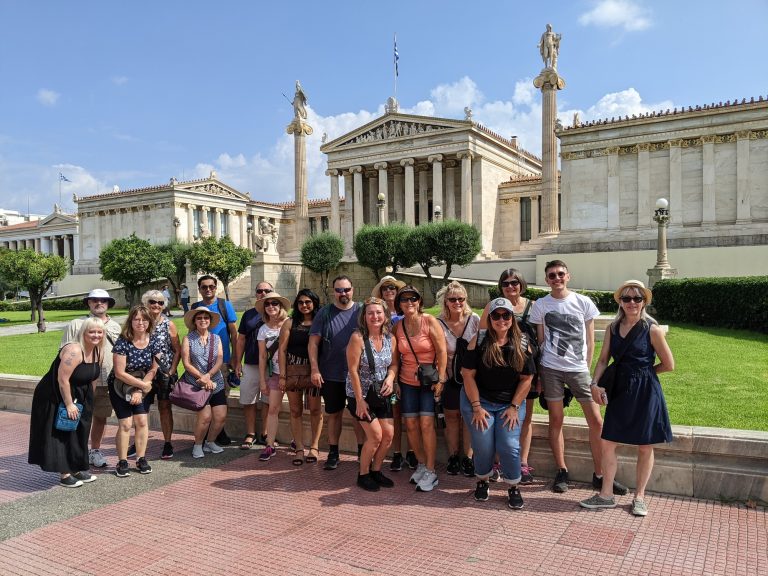
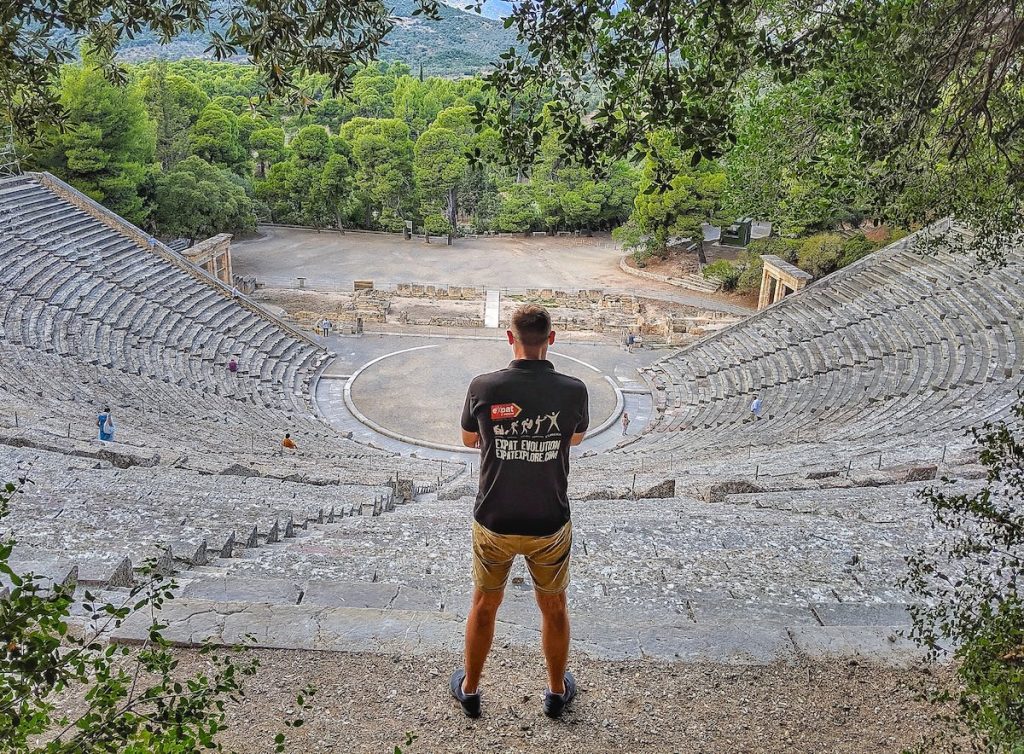
Many people are travelling to Greece to see historical monuments—Greece is home to 20 UNESCO World Heritage sites, including the Acropolis in Athens (featuring the Parthenon), Olympia (home of the ancient Olympic Games), Delphi (famous for the Oracle), Epidaurus Ancient Theatre and the Sacred Island of Delos.
However, the Greek islands have become the biggest draw, especially after the movie Mamma Mia! brought them to global attention. Below is a brief Greek islands guide about each distinct group:
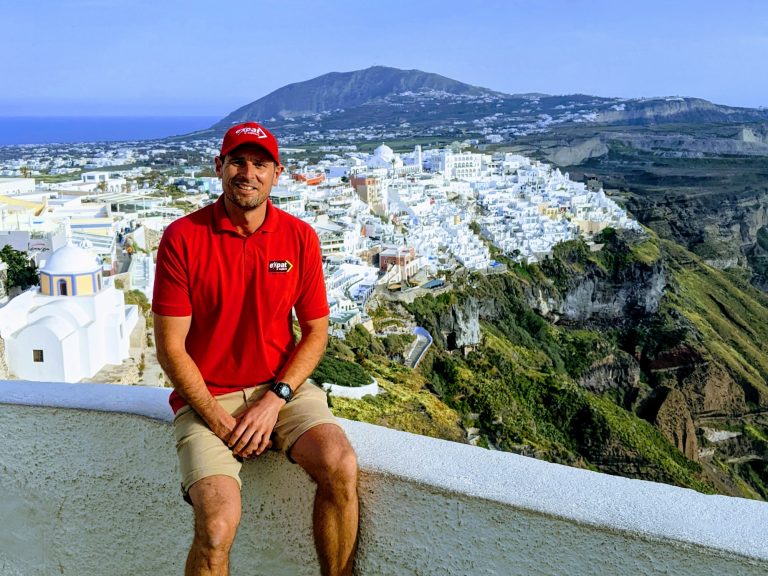
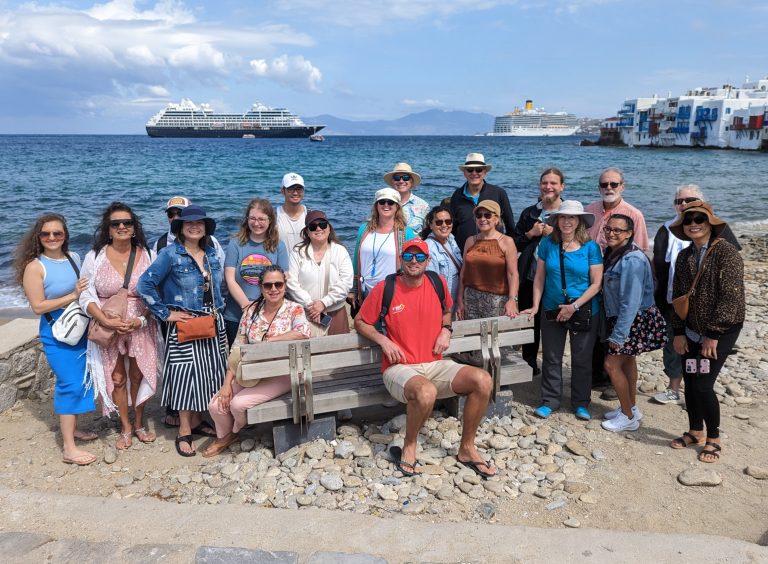
- Cycladic Islands: The jewel in the crown of Greek tourism, featuring iconic whitewashed buildings. Highlights include Santorini, Mykonos, Milos, and Naxos.
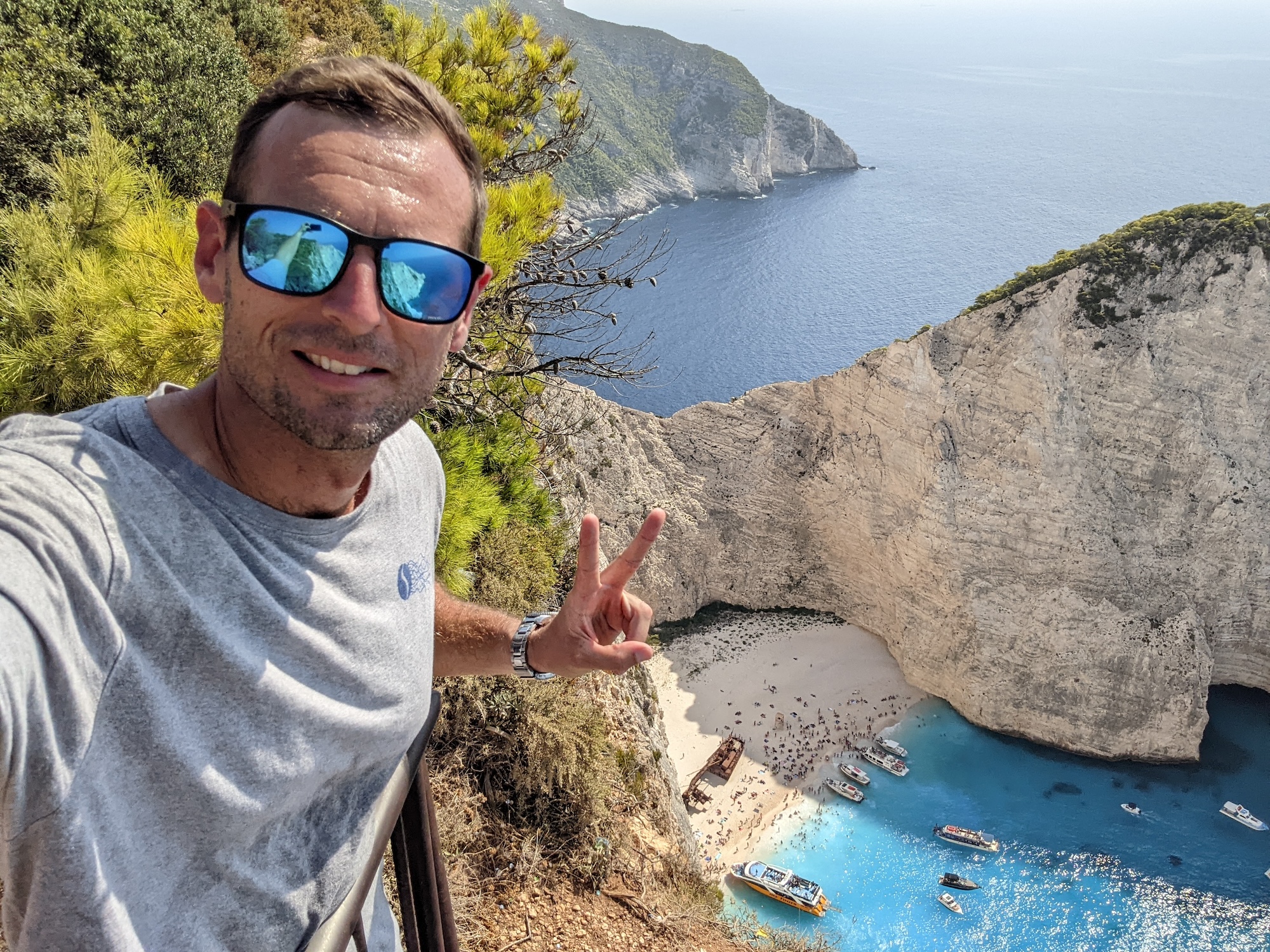
- Ionian Islands: Including Zakynthos (home to the famous Shipwreck Beach), Corfu, and Kefalonia.
- Dodecanese Islands: Including Rhodes, famed for the colossus which stood at its harbour in ancient times, one of the seven wonders of ancient times.
- North Aegean Islands: Including beautiful Samos and Lesbos.
- The Sporades: Including Skiathos and Skopelos, where Mamma Mia! was filmed.
- Saronic Islands: Including Hydra, the carless island conveniently located close to Athens.
Overwhelmed by All These Amazing Options? With so many incredible destinations—from Santorini’s sunsets to Athens’ ancient wonders—planning the perfect Greece vacation can feel daunting. That’s where a guided tour makes all the difference. Join an Expat Explore Greece tour and experience:
- ✅ Expert local guides (like me!)
- ✅ All logistics handled (transport, hotels, itinerary)
- ✅ Hidden gems only locals know
Plus: Use code ‘TOURLEADERSJOURNAL‘ for a 5% discount!
Greece Travel Guide: Culture, Food, and Traditions
Greek Food: World-Class Cuisine
Declared the world’s second-best cuisine by Taste Atlas and regarded as the healthiest, Greek food is a highlight of any visit. The Greek diet consists mainly of vegetables and seafood with generous use of high-quality olive oil, contrary to the stereotypical meat-heavy perception. As my Greek language teacher told me, “Meat should swim or fly.” Lamb was traditionally reserved for special occasions like Easter.
Some dishes are shared with other Balkan and Middle Eastern cuisines, particularly Turkish. While Greeks and Turks debate who invented certain dishes, I’ll focus on what makes Greek versions unique.
Greek Food Staples
- Olives and Olive Oil: High-quality olive oil makes the Greek diet one of the world’s healthiest. It’s used for cooking, dressing salads, and dipping bread. Don’t ask for butter at restaurants!
- Greek Yoghurt: This thicker, creamier yoghurt results from extra straining during production, making it higher in protein with less sugar.
- Tzatziki: Made from cucumber, garlic, and Greek yoghurt, this is the Greek condiment. No, there’s no ketchup.
- Cheese: Feta reigns supreme, but Greeks produce many other varieties.
- Bread: You’ll mostly find pita, the Greek flatbread, served throughout the country.
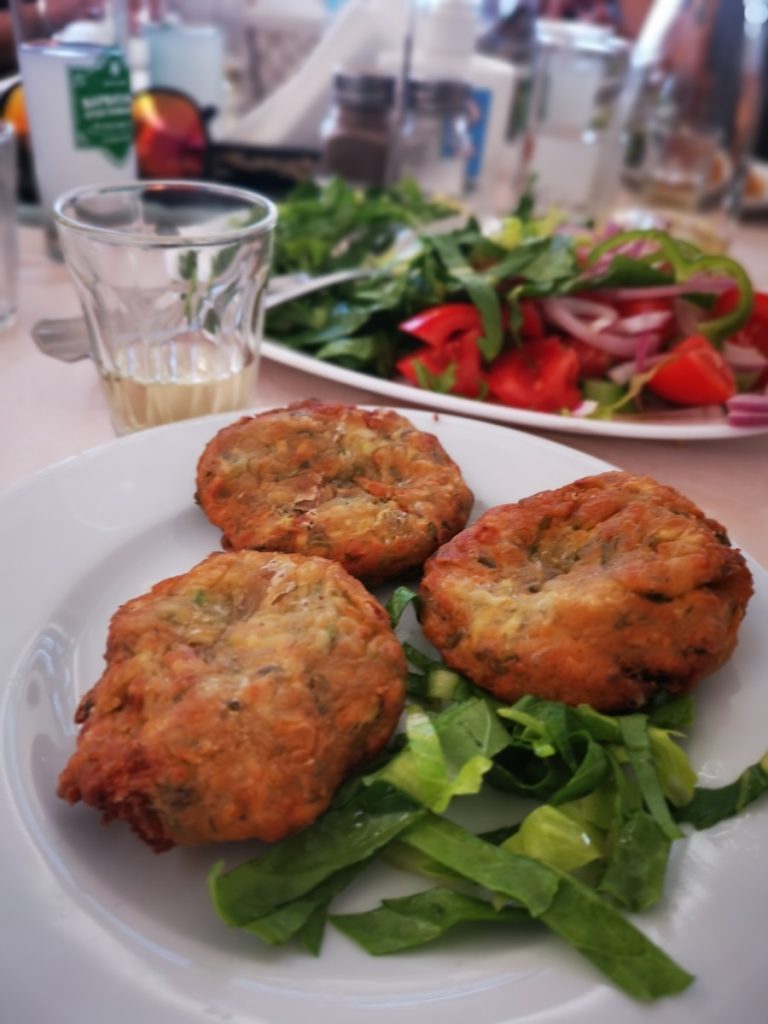
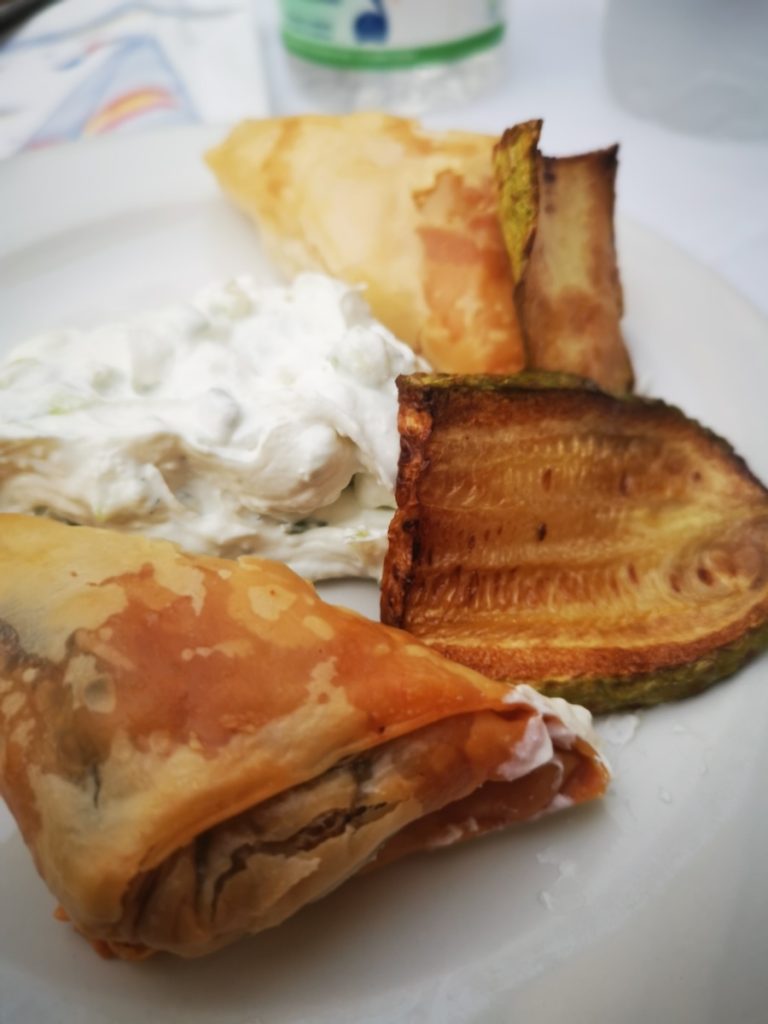
Iconic Greek Dishes
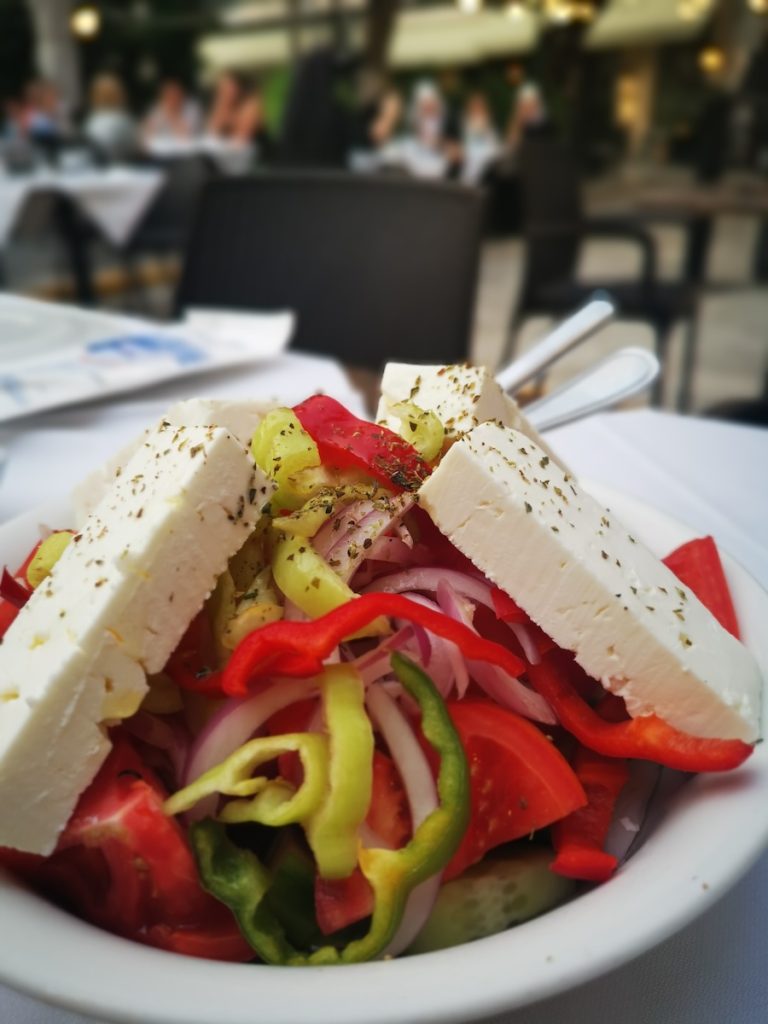
- Greek Salad (Village Salad): There’s no “Greek Salad” in Greece—it’s called Village Salad. It varies slightly throughout the country as communities add locally available ingredients, but core staples include tomato, cucumber, feta, olives, and lots of olive oil.
- Cheese Saganaki: Yellow cheese fried in a shallow pan—my absolute favorite Greek dish. For American friends: there’s no such thing as flaming saganaki in Greece; that’s an American invention.
- Spanakopita/Tiropita: Classic Greek pastries—Spinach Pie and Cheese Pie. Found in all coffee shops, they’re breakfast staples, perfect as a morning snack with coffee.
- Moussaka: The national dish features layers of vegetables (potato, eggplant, and zucchini) with a béchamel top layer, similar to lasagna but with vegetables instead of pasta sheets.
- Pastitsio: Similar to moussaka but with tubular pasta mixed in instead of vegetable layers.
- Gemista: The go-to vegetarian dish—tomatoes and peppers stuffed with rice.
Gyros, Souvlaki, and Kebab (Street Food)
When travelling to Greece, you’ll want to enjoy iconic pita wraps, but there’s some confusion about terminology:
- Gyros: This is shaved meat from a rotisserie (in Turkey, it’s called döner kebab). If you order “Chicken Gyros” at a sit-down restaurant, you’ll likely receive a full plate of meat with fries and salad. Specify “pita wrap” to avoid confusion. Usually either pork or chicken.
- Souvlaki: This is meat on a stick and again, is usually available as either pork or chicken. Sometimes a big metal skewer, sometimes it’s on little wooden sticks. This is more commonly served as a sit-down meal, but can also be served in a wrap for takeaway.
- Kebabs: In Greece, these are minced meat sausages similar to Cevapi found in the Balkans, also available by the plate or in a wrap.
Greek Desserts
Greeks don’t take desserts too seriously—it’s normally something simple like watermelon or Greek yoghurt with honey and nuts. But if you have a sweet tooth, look for these staples:
- Baklava: A common sweet in this region, heavy in nuts and honey. Many tavernas offer complimentary small baklava after meals.
- Loukoumades: Greek doughnuts—fried dough balls traditionally covered in honey. Today, you’ll find shops serving loukoumades with a wide selection of fillings and toppings.
- Loukoumi: You’d probably recognise these gelatin treats as Turkish Delight, but don’t call anything “Turkish” in Greece! Traditionally enjoyed with Greek coffee.
Do Greeks smash plates?
This was once a tradition starting at funerals, where people smashed plates after meals to ward off evil spirits. Potters encouraged the practice, and it found its way into weddings and other celebrations. It’s now illegal, though, and restaurants won’t appreciate you smashing their plates!
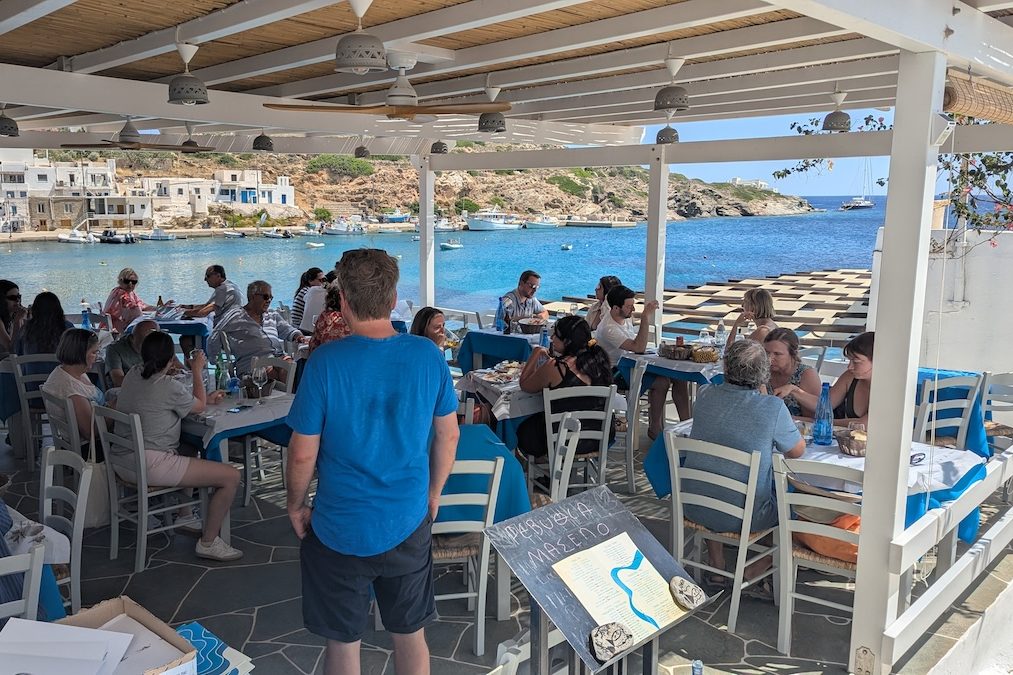
Greek Drinks: Wine, Spirits, Beer, and Coffee
Wine
Greeks have been growing grapes for wine for over 6,000 years, and wine remains integral to Greek culture. However, you won’t find the upmarket wine industry like in France or Italy with fancy bottles.
At tavernas, there’s no wine menu. Your choices are white, red, or rosé, coming in bulk from local regional wineries. You only choose quantity—a glass or a one-litre jug?
A special twist is Retsina—white or rosé mixed with pine resin. This tradition dates back to pre-Roman times, before wine was stored in barrels. Great with meze and seafood!
Liquor
- Ouzo: Typically served with meze, this aniseed-flavoured liquor is diluted with water and ice for sipping—not for shots! 37.5%–50% ABV.
- Tsipouro/Raki: For a stronger kick, try the Greek version of grappa. This potent liquor is made from leftover grape skins. Opa! 40%–45% ABV.
- Mastika: A lighter spirit, particularly popular as an after-dinner digestive. Made from the mastika plant native to Chios, it’s sweet and lower in alcohol, best served chilled. 15%–30% ABV.
- Metaxa: A type of Greek brandy mixed with Muscat wine, best served neat over ice. Typically 38%–40% ABV.
Beer
While traditionally a wine-drinking nation, today Greece has a thriving beer scene with many locally produced beers. This is thanks to their first king, Otto, from Bavaria, Germany—the holy land of beer production!
Most beers are light and refreshing pilsners/lagers, perfect in a frosted glass on a hot summer’s day.
- Fix Hellas: The first beer brewed in Greece, dating back to 1864 by Bavarian immigrant Johann Ludwig Fuchs. Greeks couldn’t pronounce Fuchs, so it became Fix. Now owned by Olympic Brewery (part of the Carlsberg group), it’s a well-known premium lager.
- Mythos: Established in 1997 with German heritage, also part of Olympic Brewery. A great lager and my personal favourite, especially when enjoying sunshine on the Greek islands.
- Alfa: Probably the most common, particularly on the mainland, brewed by Athenian Brewery (part of the Heineken group). Originally established to produce Amstel, then later Heineken (both still commonly found), Alfa was relaunched in 2000, having originally been produced in 1961. It’s a very refreshing blonde lager.
- Mamos: A recent readdition to the Greek market by Athenian Brewery. Originally dating back to 1876, it’s a pilsner-style beer unique in taste, utilising three types of hops.
Coffee
Coffee culture in Greece is huge. It’s hard to believe they’re not the world’s top coffee consumers! Young Greeks meet for coffee to escape their small apartments at home with parents. My Greek drivers always had coffee while driving—sometimes loaded up with two or three coffees so they’d never be without.
Coffee preparation is uniquely Greek, with influences from Italy and Turkey. Here’s what you’ll find at coffee shops on every corner:
- Greek Coffee: Prepared in a special vessel called a briki with cold water and powdered coffee, then placed on a heating element (traditionally hot sand, which is why you might see a bowl of sand at hotel breakfast buffets). Please don’t call this Turkish Coffee in Greece—you won’t make friends! They share the tradition of turning the empty cup upside down and telling fortunes from it.
- Freddo Espresso/Cappuccino: Freddo means “iced” in Italian, so these are iced coffees. Made in Italian barista style with a double shot poured over ice, then stretched with a stick blender along with sugar. This is poured over fresh ice for freddo espresso, or frothed milk is added for freddo cappuccino. Ask for metrio (a little sugar) or sketo (no sugar) if you don’t want it sweet.
- Frappé: Ice blended with coffee, more common in Thessaloniki.
- Cappuccino: You’ll find Italian staples like cappuccino, but note that in Greece, they sprinkle cinnamon on top instead of chocolate powder.
Religion in Greece: Orthodox Christianity
Ninety percent of Greeks still consider themselves part of the Greek Orthodox Church. Unlike other countries, Greece remains very religious due to the church’s role in maintaining Greek national identity during Ottoman rule, though church attendance is dropping among younger generations.
Easter is the year’s most important religious festival, even more than Christmas. Families come together after Lent to roast lamb on a rotisserie—this is where the stereotype of Greeks eating lamb originates.
Greece’s most spiritual place is Mount Athos, a self-governed monastic community with 20 monasteries. Although visiting is extremely limited, with a complete ban on women and children.
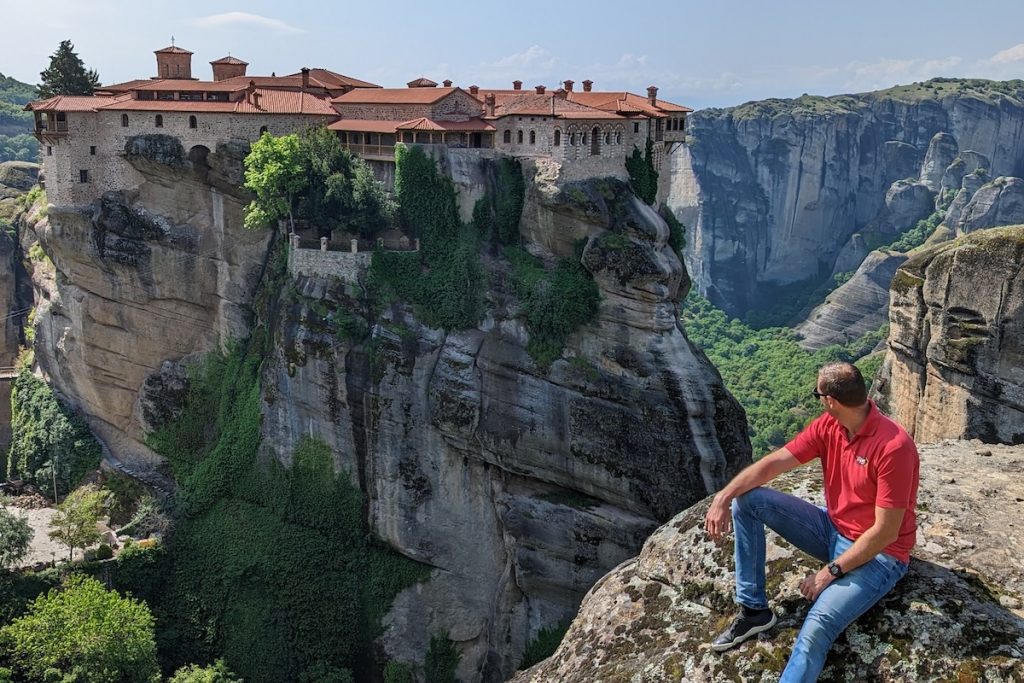
A more welcoming alternative is the monasteries at Meteora, an underrated destination featuring monasteries built atop narrow cliffs, appearing to float in the sky. If you’d like to know more, check out my Meteora travel guide.
You may enter Orthodox churches when travelling to Greece, but note the dress code: ladies should have knees and shoulders covered, while men should remove their hats.
Sports in Greece: Ancient and Modern
The ancient Olympic Games were first held in 776 BCE at Olympia to honour Zeus and the Olympian gods, running every four years for nearly 1,200 years until Christianity’s arrival.
The modern Olympics were also born in Greece, initially held in Athens in 1896 to bring the international community together. Greece hosted again in 2004 and is always the first team to march at the opening ceremonies.
At the first modern Olympics, the Marathon race was born, replicating Pheidippides’ legendary run from the battlefield at Marathon to Athens to announce their unexpected victory over the Persians. The Athens Marathon, held every November, is one of the world’s most prestigious marathons, starting in Marathon and ending at the first modern Olympic Stadium.
As part of the European community, football (soccer) is the favoured spectator sport. Greece’s national league is Super League Greece, featuring 14 teams. They’ve qualified for the World Cup only three times, but standards are improving—they’ve moved up to 11th in European rankings. Basketball also has a major following in Greece.
Greek Music and Film
The classic sound in Greek music comes from a special guitar called a bouzouki. You’ll see it sold in souvenir stores and recognize it by its bulb-like shape. Some tavernas have bouzouki players, which really adds to the authentic dining experience.
Zorba the Greek: The most iconic song is “Zorba,” featured in the 1964 film Zorba the Greek starring Anthony Quinn. The tune comes from the final scene, accompanying a dance routine that has also become iconic.
Never on Sunday: A famous Greek romantic comedy set in the Port of Piraeus in Athens, premiering in 1960. The title song (“Ta Paidiá tou Pireá”) won an Oscar for Best Original Song.
For modern Greek music, check out Konstantinos Argiros, who has become a global pop icon.
Essential Greek Phrases for Travelers
Greeks are well-educated, and most people you encounter will speak English fluently. However, as a courteous traveler, it’s always good to know the basics:
- Good morning – Kalimera
- Good evening – Kalispera
- Hello – Yassas/Yassou (formal/informal)
- Sorry/Excuse me – Signomi
- Yes/No – Ne/Ochi
- Please/You’re welcome – Parakalo
- Thank you – Efharisto
- Do you speak English? – Milate Anglika?
- Cheers – Yamas
- Bon appétit – Kali oreksi
Greece Travel Tips: Need to knows when travelling to Greece
Whilst Greece is a fantastic country to travel to, there are a few things to be aware of, and no Greece Travel Guide would be complete without mentioning them:
- Drinking water: In Athens, it’s generally safe to drink the tap water, but on the islands, it’s bottled water all the way. The islands have no natural water sources, and the tap water is poorly desalinated, fine for cooking and showering etc, but not for drinking.
- Toilet paper: This will be a bit of a shock for some people, but in Greece, you can’t flush the toilet paper. It goes into the little bin next to the toilet. Supposedly, when Greece was developing, they used too narrow pipes, and paper often causes clogs. It’s weird at first but you get used to it.
- Smoking: Smoking in Greece is still quite common, including in cafes and restaurants. If you’re going to places where other tourists go, it shouldn’t be a problem, but if you go to a more local spot, don’t be surprised if people light up at the table next to you.
- Safety: Like any busy place with tourists in Europe, you need to be aware of pickpockets. On the metro system and at all the main tourist sights in Athens, be alert. Oia, in Santorini, is also a hotspot for thieves, as people are too busy taking photos and enjoying the views.
Start Planning Your Greek Adventure
I hope this Greece travel guide has inspired. Despite Greeks living worldwide and bringing their culture with them, only in Greece can you truly appreciate the Greek way of life.
Whether you’re soaking up the sun on the Aegean, being amazed by historical monuments, savoring world-class cuisine, or experiencing warm Greek hospitality, your time in Greece will be one of the most memorable journeys you’ll ever embark upon.
Ready to experience Greece for yourself? For a hassle-free way to explore the best of this incredible country, leave your Greece vacation planning to the experts and consider joining a guided group tour that covers all the highlights with expert local guides. From Athens’ ancient wonders to Santorini’s stunning sunsets, a well-planned tour ensures you don’t miss a thing.
For more Greece travel guides, explore my articles on Athens, Meteora, Santorini, and Mykonos.
Yamas! (Cheers to your Greek adventure!)